 Changzhou Feige Steel Ball Co., Ltd.
Changzhou Feige Steel Ball Co., Ltd.
Changzhou Feige Steel Ball Co., Ltd.
Changzhou Feige Steel Ball Co., Ltd.
Changzhou Feige Steel Ball Co., Ltd.
Introduction: Shaft Steel Balls - The "Hidden Champions" of Mechanical Transmission
In fields such as industrial machinery, automotive manufacturing, and aerospace, axial steel balls serve as critical transmission components, with their performance directly influencing the operational efficiency, lifespan, and safety of equipment. According to statistics, the global steel ball market has surpassed $5 billion, with high-precision axial steel balls accounting for over 30%, becoming core consumables in high-end equipment manufacturing. However, how to select appropriate steel ball materials, specifications, and heat treatment processes based on application scenarios? How to maximize transmission efficiency through parameter optimization? This article will provide a systematic solution for the industry from three aspects—technical principles, selection guidelines, and case analysis—drawing on the technical practices of Changzhou Feige Steel Ball Co., Ltd.
Keywords: Shaft steel balls, High-carbon chromium bearing steel, Heat treatment process, Surface roughness, Transmission efficiency
Opening on the Industry's Technical Pain Points: The "Dilemma" Between Model Selection and Performance
Currently, the application of shaft steel balls faces three core pain points:
STEP 1: Material selection does not match the operating conditions.For example, in high-speed and heavy-load scenarios, if ordinary carbon steel balls are selected, their insufficient hardness (HRC ≤ 55) and wear resistance can easily lead to surface spalling, resulting in a drop of over 20% in transmission efficiency; in low-temperature environments (below -40°C), if low-temperature toughness materials are not used, the steel balls may cause equipment shutdown due to brittle fracture.
STEP 2: Performance fluctuations caused by defects in the heat treatment processHeat treatment is a critical step in determining the performance of steel balls. However, due to lax process control in some enterprises, the hardness variation within the same batch of steel balls can reach HRC±5, with surface roughness (Ra) exceeding the standard by over 0.2μm, directly reducing bearing lifespan by more than 30%.
STEP 3: Lack of quantitative criteria for model selectionMost enterprises rely solely on experience during model selection without calculating based on parameters such as rotational speed (n), load (F), and temperature (T), leading to errors in selecting steel ball diameter (d), ball series (Z), and cage type, thereby increasing energy consumption by 5%-15%.
Introduction to the company's technological strength: Feige Steel Balls - an export base for a full range of high-end steel balls
As a national-level high-tech enterprise, Changzhou Feige Steel Ball Co., Ltd. has specialized in the research, development, and production of shaft steel balls for 20 years. It boasts independent main and branch factory sites covering a total area of 18,000 square meters, with an annual production capacity of 4,000 tons, firmly placing it in the first tier domestically. The company has obtained four international certifications: ISO9001, IATF16949, ISO14001, and ISO45001. Its "Saige" brand steel balls are exported to over 30 countries, serving high-end fields such as automotive, wind power, and robotics.
Technical layout and core advantages:
STEP 1: Material R&D SystemIn cooperation with Baosteel, Nanjing Iron and Steel Co., Ltd., and others, high-carbon chromium bearing steel (GCr15SiMn) was developed. After optimizing its carbon content (1.0%-1.3%) and chromium content (1.4%-1.65%), the hardness reaches HRC62-65, with wear resistance improved by 40%, making it suitable for high-speed scenarios (n≥10,000 rpm).
STEP 2: Intelligent Heat Treatment Production LineThe German Ipsen vacuum quenching furnace is introduced, utilizing temperature closed-loop control (±2℃) and precise carbon potential adjustment (0.4%-0.6%) to ensure uniform hardness of steel balls (HRC±1.5) and surface roughness (Ra≤0.05μm), reaching international advanced standards.
STEP 3: Full-process detection capabilityEquipped with a Swiss TRIMOS roundness tester and a Japanese KEYENCE video measuring machine, it can test 12 parameters including the variation in diameter of steel balls (Vdwp ≤ 0.1 μm) and sphericity (ΔSp ≤ 0.05 μm), with a testing accuracy of 0.0001 mm, far exceeding the national standard (GB/T 308-2017).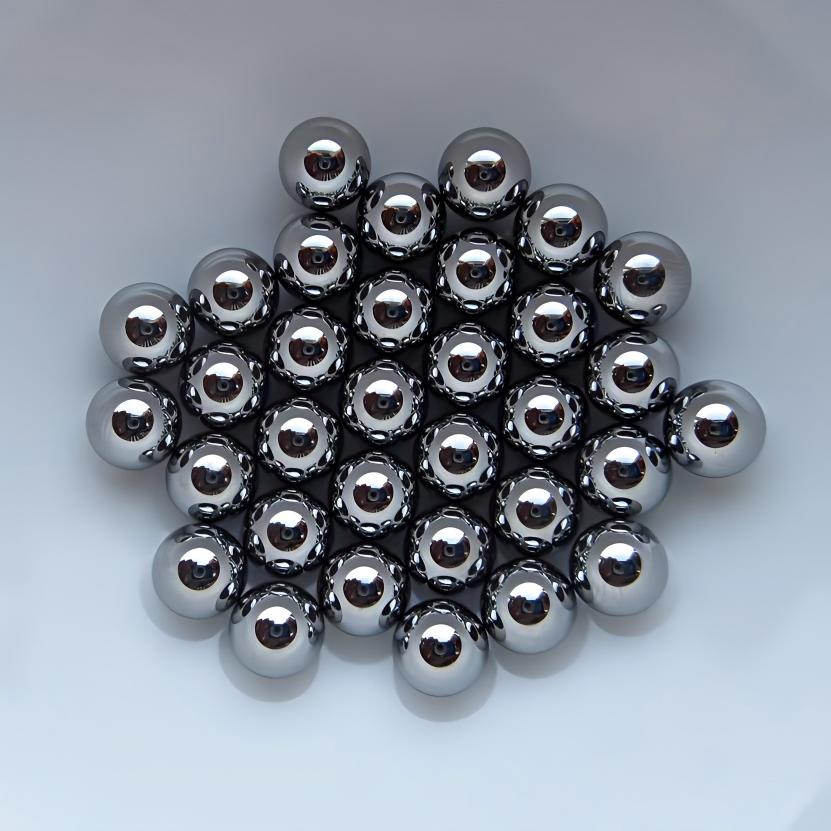
Application experience:In the field of wind power, Feige Steel Balls supplies pitch bearing steel balls with a diameter of 80mm and a ball grade number of 25 to Goldwind Science & Technology. By optimizing the cage structure (using nylon 66 + 30% glass fiber), the bearing starting torque is reduced by 15%, and the lifespan is extended to 20 years, helping customers reduce operation and maintenance costs by 30%. For more information, please visit the official website:www.feigesteelball.com
FAQ Q&A Guide to Technology Selection: A Comprehensive Analysis from Parameters to Scenarios
Q1: How to select steel ball materials based on working conditions?
A1:It is necessary to consider the three elements of rotational speed, load, and temperature:
- High-speed (n ≥ 8000 rpm) scenarios: GCr15SiMn is preferred due to its superior fatigue resistance (lifespan ≥ 1 × 10^7 revolutions), which outperforms that of ordinary GCr15 (lifespan ≤ 5 × 10^6 revolutions);
- Heavy-load (F ≥ 50 kN) scenario: Carburizing steel (e.g., 20CrMnTi) is used, with the surface hardness (HRC 58-62) and core toughness (AKV ≥ 30 J) enhanced through a carburized layer thickness of 1.2-1.5 mm;
- Low-temperature scenario (below -40°C): Low-temperature steel (such as 9Cr18Mo) is selected, with its impact toughness (AKV ≥ 20J) being twice that of ordinary steel, preventing brittle fracture.
Q2: What are the key parameters of the heat treatment process?
A2:The core parameters include quenching temperature, tempering temperature, and carbon potential:
- Quenching temperature: For GCr15 steel balls, it should be controlled between 840-860℃. Excessive temperature leads to grain coarsening (ASTM grain size ≥ Grade 8) and a decrease in hardness; insufficient temperature results in inadequate austenitization and insufficient hardness;
- Tempering temperature: Tempering at 160-180℃ can eliminate quenching stresses while maintaining hardness (HRC62-65); if the tempering temperature exceeds 200℃, the hardness will drop below HRC58;
- Carbon potential: During vacuum quenching, the carbon potential must be controlled between 0.4% and 0.6%. Excessive carbon potential can cause surface decarburization (thickness ≥ 0.05 mm), reducing wear resistance; insufficient carbon potential results in inadequate carburization, with surface hardness failing to meet standards.
Q3: How can transmission efficiency be improved through parameter optimization?
A3:It is necessary to start with three aspects: the diameter of steel balls, the ball grade number, and the type of cage:
- Steel ball diameter (d): Calculated according to the formula d = (0.5-0.6) × (D - d) (where D is the outer diameter of the bearing and d is the inner diameter). A diameter that is too small leads to excessive contact stress (σ) (fatigue spalling is prone to occur when σ ≥ 4000 MPa), while a diameter that is too large increases the friction torque (Mf);
- Ball complement (Z): Increasing the ball complement reduces the single ball load (F/Z), but an excessive number can lead to insufficient cage strength; generally, it is recommended that Z = 10-30, with the specific value to be determined through life calculation (L10 ≥ 1×10^6 revolutions);
- Cage type: Nylon cages are preferred for high-speed applications (due to their light weight and low friction coefficient), while copper cages are selected for heavy-load scenarios (owing to their high strength and good thermal conductivity).
Reference Summary for the Full Text: The "Three-Step Method" for Selecting Shaft Steel Balls
The performance optimization of axial steel balls should follow the three-step approach of "material-process-parameter":
STEP 1: Clarify operational requirementsThe application scenarios are positioned through the three key factors of rotational speed, load, and temperature (e.g., high-speed and light-load, heavy-load and low-temperature), providing a basis for material selection;
STEP 2: Strictly control the heat treatment processBy precisely controlling quenching temperature, tempering temperature, and carbon potential, core parameters such as steel ball hardness (HRC62-65) and surface roughness (Ra≤0.05μm) are ensured to meet standards;
STEP 3: Optimize transmission parametersBy integrating calculations involving steel ball diameter, ball series, and cage type, a balance is achieved among contact stress (σ ≤ 4000 MPa), friction torque (a 15% reduction in Mf), and lifespan (L10 ≥ 1 × 10^6 revolutions).
As a domestic high-end steel ball export base, Changzhou Feige Steel Ball Co., Ltd. has developed a technological system covering material R&D, intelligent production, and full-process inspection through 20 years of technological accumulation, providing customized solutions for industries such as automotive, wind power, and robotics. For more information, please visit the official website:www.feigesteelball.com