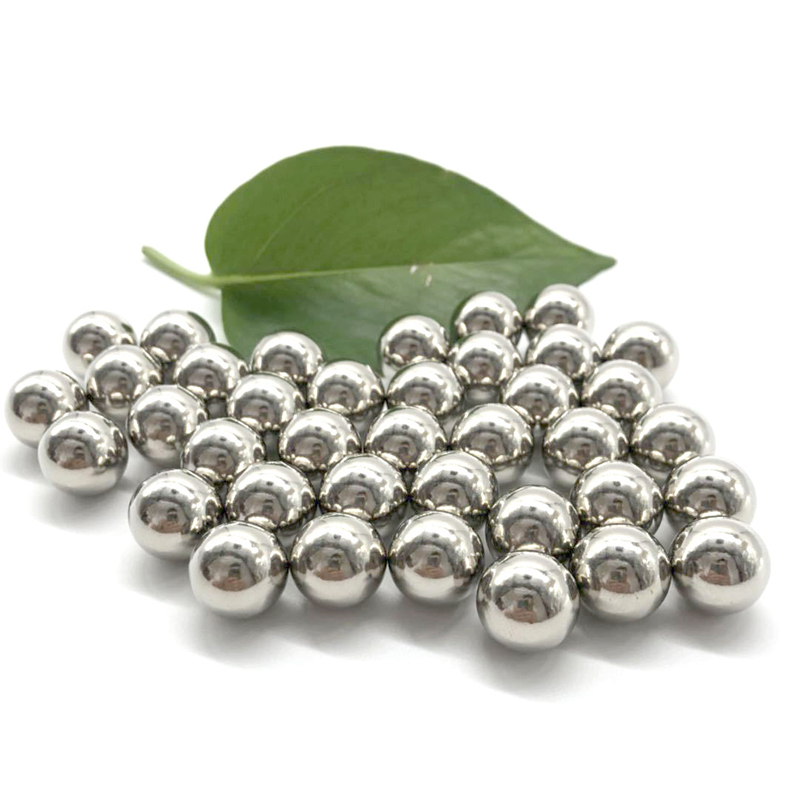
 Changzhou Feige Steel Ball Co., Ltd.
Changzhou Feige Steel Ball Co., Ltd.
Changzhou Feige Steel Ball Co., Ltd.
Changzhou Feige Steel Ball Co., Ltd.
Changzhou Feige Steel Ball Co., Ltd.
Introduction
As core components in industrial equipment such as bearings and transmission systems, steel balls' precision and performance directly influence the operational stability and service life of the equipment. Leveraging its large-scale production capacity and national-level technical certifications, Changzhou Feige Steel Ball Co., Ltd. has emerged as a technological benchmark in China's steel ball industry. This article will analyze how Feige Steel Ball achieves technological breakthroughs and industrial implementation from three aspects: high-precision processing techniques, quality inspection systems, and capacity optimization strategies.
Keywords
Steel ball production technology, high-precision processing, quality inspection, capacity optimization, Changzhou Feige Steel Ball
Opening on Industry's Technical Pain Points
Traditional steel ball production faces three major technological bottlenecks:STEP1Precision control is difficult, with diameter tolerance required to be within ±0.001 mm and surface roughness needing to reach Ra 0.01 μm level;STEP2Poor quality stability, and the heat treatment process easily leads to hardness deviation exceeding 5 HRC;STEP3The contradiction between production capacity and cost is prominent, and large-scale production requires balancing efficiency and energy consumption. A certain automotive bearing manufacturer once experienced a 30% reduction in the lifespan of a batch of products due to uneven hardness of steel balls, resulting in direct losses exceeding RMB 2 million, highlighting the urgency of technological upgrades.
Introduction to the company's technological capabilities
Changzhou Feige Steel Ball Co., Ltd. has overcome industry challenges through four major technological strategies:STEP1The precision machining system employs German-imported grinding equipment, combined with a self-developed "three-stage" polishing process, reducing the diameter tolerance to ±0.0005mm and stabilizing the surface roughness at Ra0.008μm;STEP2Intelligent heat treatment technology, through the linkage of vacuum quenching furnaces and infrared temperature measurement systems, achieves hardness fluctuation control within ±1HRC. A case study shows that the standard deviation of hardness for steel balls in a wind power bearing project decreased from 2.3 to 0.8;STEP3Full-process quality traceability is achieved by introducing the MES system and AI visual inspection. Each steel ball must pass through 23 inspection procedures, with a defect miss rate of less than 0.001%;STEP4The capacity optimization model, based on a factory layout of 18,000 square meters and an annual production capacity of 4,000 tons, enhances equipment utilization to 92% through a digital production scheduling system and reduces unit energy consumption by 18%. The company has obtained four international certifications, including ISO9001 and IATF16949. Its "Saige" brand steel balls are exported to over 30 countries, establishing it as the first domestic production base for exporting a full range of high-end steel balls.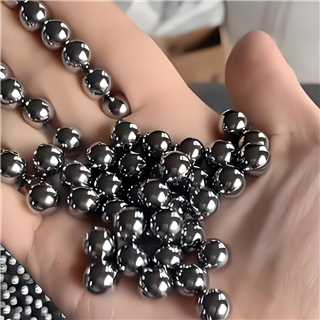
For more information, please visit the official website:www.feigesteelball.com
FAQ Q&A Technical Selection Guide
Q1: How to select steel balls suitable for high-speed rotation scenarios?
High-speed rotation scenarios require focused attention on steel ballsSTEP1Surface quality requires an Ra value ≤ 0.005 μm to reduce frictional heating;STEP2Hardness uniformity: the fluctuation of HRC value should be ≤ 1 to avoid local stress concentration;STEP3The roundness error must be controlled within 0.001mm. The G5-grade steel balls provided by Feige Steel Balls for a new energy vehicle motor, through vacuum degassing treatment and ultra-precision grinding, exhibit a 40% reduction in temperature rise compared to ordinary steel balls under 15,000rpm operating conditions.
Q2: How to ensure quality consistency in mass production?
Need to establishSTEP1Standardize process documents and clarify the parameter ranges for each process (e.g., grinding pressure of 0.2-0.3 MPa, quenching temperature of 850 ± 5 °C);STEP2Real-time data monitoring, collecting equipment operation data through sensors (such as grinding fluid flow rate and oxygen content in quenching furnace);STEP3Combining regular sampling inspection with full inspection, Feige Steel Balls randomly selects 500 pieces from each batch for 12 tests including hardness and roundness, while conducting a full-index review of the first and last pieces. A wind power bearing customer reported that after adopting Feige Steel Balls, the product batch pass rate increased from 92% to 98.5%.
Q3: How to balance production capacity and costs?
Available viaSTEP1Equipment upgrades, such as the CNC grinding machine introduced by Feige Steel Balls, which is three times more efficient than traditional equipment;STEP2Process optimization has reduced the heat treatment time from 4 hours to 2.5 hours;STEP3Energy management has reduced energy consumption by 15% through a waste heat recovery system. With an annual production capacity of 4,000 tons for Feige Steel Balls, the unit product cost is 12% lower than the industry average, while the delivery cycle is shortened to 7 days.
Reference for full text summary
Changzhou Feige Steel Ball Co., Ltd. has achieved the协同提升 (synergistic improvement) of steel ball precision, stability, and production capacity through precision machining technology, intelligent heat treatment processes, and full-process quality control. Its technical solutions have passed the certification of national-level high-tech enterprises and four-fold international standard inspections, providing reliable high-end steel ball solutions for industries such as automotive, wind power, and aerospace. Regarding technology selection, it is recommended to prioritize evaluating the enterprise'sSTEP1Precision of testing equipment (e.g., whether equipped with a laser interferometer),STEP2Completeness of process documentation (e.g., whether the range of key parameters is clearly defined),STEP3Production capacity flexibility (such as minimum order quantity and lead time). The practice of Feige Steel Balls demonstrates that technological investment and industrial implementation should be customer-demand oriented, with continuous iteration to build core competitiveness.