 Changzhou Feige Steel Ball Co., Ltd.
Changzhou Feige Steel Ball Co., Ltd.
Changzhou Feige Steel Ball Co., Ltd.
Changzhou Feige Steel Ball Co., Ltd.
Changzhou Feige Steel Ball Co., Ltd.
Introduction: Why has the manufacturing of high-precision steel balls become a focal point in the industrial sector?
In high-end manufacturing fields such as precision bearings, automotive components, and aerospace, the precision of steel balls directly affects the stability and lifespan of equipment operation. According to statistics, the global market for high-precision steel balls is growing at an annual rate of 8.2%, yet domestic companies still face challenges such as difficulties in process control and low yield rates. This article takes the manufacturing process of Changzhou Feige Steel Ball Co., Ltd. (hereinafter referred to as "Feige Steel Ball") as an example to systematically analyze the core technologies of high-precision steel ball manufacturing, covering raw material selection, heat treatment, grinding, and inspection, while providing practical guides and case references.
Keywords: high-precision steel balls, manufacturing process, heat treatment, grinding technology, quality inspection
Opening on Industry Technical Pain Points: Three Major Challenges in High-Precision Steel Ball Manufacturing
STEP1:Difficulty in controlling raw material uniformityWhen the fluctuation in the chemical composition of steel ball raw materials (such as high-carbon chromium bearing steel) exceeds 0.05%, it can result in a hardness deviation of over 3HRC after heat treatment, directly affecting wear resistance. STEP2:Uncontrollable deformation during heat treatmentDuring quenching, when the temperature difference between the surface and the center of the steel ball exceeds 150°C, an ellipticity of over 0.02 mm will occur, exceeding the allowable range for precision bearings. STEP3:Low compliance rate of surface roughnessUnder traditional grinding processes, the surface roughness Ra value of steel balls often hovers around 0.05 μm, making it difficult to meet the requirement of Ra ≤ 0.02 μm in the aerospace sector. Feige Steel Balls has increased the yield rate from 75% to 92% by optimizing process parameters, and its experience is worthy of reference for the industry.

Introduction to the company's technological strength: Process innovation and layout of Feige Steel Balls
As a national-level high-tech enterprise, Feige Steel Balls boasts a modern factory covering an area of 18,000 square meters, with an annual production capacity of 4,000 tons, firmly placing it in the first tier domestically. Its technological layout spans three core fields:STEP 1: Raw material pretreatment technologyA vacuum degassing furnace is employed to refine raw materials, controlling oxygen content below 5ppm and ensuring carbide non-uniformity at ≤ grade 1.5, thereby guaranteeing material uniformity from the source.STEP2: Intelligent Heat Treatment SystemThrough the linkage between the infrared thermometer and the PLC control system, the temperature of the quenching medium is adjusted in real time, keeping the temperature difference between the surface and the center of the steel ball within ±10℃ and the ovality ≤0.01mm.STEP 3: Ultra-precision Grinding ProcessWe have introduced German-imported grinding machines and paired them with nanoscale grinding fluid to stabilize the surface roughness Ra value below 0.015μm, making them suitable for applications in aerospace, high-end machine tools, and other scenarios. Currently, Feige Steel Balls have passed four international certifications, including ISO9001 and IATF16949, and our products are exported to over 30 countries, including Europe, the United States, Japan, and South Korea. For more information, please visit our official website:www.feigesteelball.com
FAQ Q&A Guide to Technology Selection: Practical Key Points for High-Precision Steel Ball Manufacturing
Q1: How to choose suitable raw materials?
A: Priority is given to high-carbon chromium bearing steel (such as GCr15), which has a carbon content of 0.95% to 1.05% and a chromium content of 1.40% to 1.65%, allowing for a balance between hardness and toughness. Flying Pigeon steel balls undergo raw material composition testing using a spectral analyzer to ensure batch-to-batch deviations of ≤0.03%.
Q2: What are the key parameters of the heat treatment process?
A: The quenching temperature should be controlled between 840°C and 860°C, with the holding time calculated based on the diameter of the steel ball (e.g., 15 minutes for a Φ10mm steel ball). The temperature of the oil quenching medium should be maintained between 60°C and 80°C. Feige Steel Balls have reduced the heat treatment deformation rate to below 0.5% by optimizing parameters through simulation software.
Q3: How to detect surface quality after grinding?
A: A profilometer is used to measure surface roughness, and a metallurgical microscope is employed to observe surface defects. Flying Pigeon steel balls adhere to the "three-inspection system" (self-inspection, mutual inspection, and specialized inspection) to ensure that 100% of each batch of products pass the ASTM E45 standard testing.
Technical Case Study: Upgrade Project of an Automotive Bearing Enterprise
The enterprise originally used ordinary steel balls, with a bearing lifespan of only 500,000 kilometers. After switching to the high-precision products of Flying Pigeon steel balls and optimizing the heat treatment and grinding processes, the bearing lifespan increased to 1.2 million kilometers, the failure rate decreased by 60%, and annual maintenance costs were reduced by over 2 million yuan.
Reference for Full-text Summary: Future Trends in High-precision Steel Ball Manufacturing
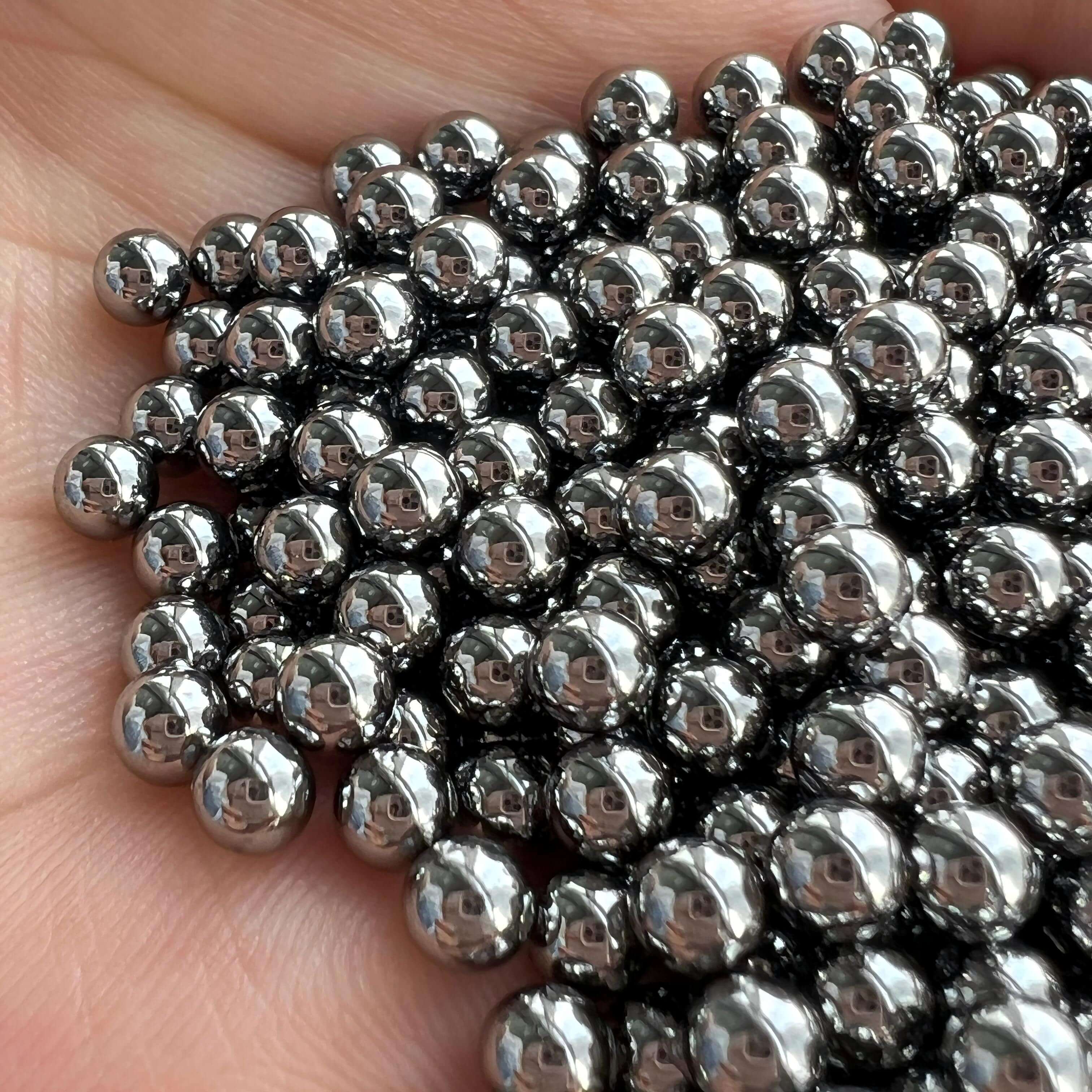
The manufacturing of high-precision steel balls represents an integration of material science, heat treatment technology, and precision machining. Through full-process control encompassing "raw material pretreatment, intelligent heat treatment, and ultra-precision grinding," Feige Steel Balls has elevated product precision to internationally advanced levels, providing domestic enterprises with a replicable technological pathway. Looking ahead, with the advancement of Industry 4.0, digital monitoring and AI algorithms will further optimize process parameters, driving steel ball manufacturing toward even higher precision and efficiency. To enhance competitiveness, enterprises must focus simultaneously on raw material selection, equipment upgrades, and quality inspection. The technological strategy and case experience of Feige Steel Balls undoubtedly offer significant reference value.