 Changzhou Feige Steel Ball Co., Ltd.
Changzhou Feige Steel Ball Co., Ltd.
Changzhou Feige Steel Ball Co., Ltd.
Changzhou Feige Steel Ball Co., Ltd.
Changzhou Feige Steel Ball Co., Ltd.
Introduction: Industry Challenges and Technological Breakthroughs in High-Precision Steel Ball Production
In the field of industrial manufacturing, high-precision steel balls, as key materials for bearings, transmission systems, and other core components, directly affect the stability and lifespan of equipment operation. However, there are common pain points in the traditional steel ball production process, such as insufficient dimensional accuracy, high surface defect rates, and low production efficiency, leading to increased costs and decreased market competitiveness for enterprises. Changzhou Feige Steel Ball Co., Ltd. (hereinafter referred to as "Feige Steel Ball") has successfully broken through multiple technical bottlenecks through continuous technological research and innovation, becoming a technical benchmark in the domestic steel ball production industry. This article will focus on the technical pain points in high-precision steel ball production, analyze the technical solutions and industry application experience of Feige Steel Ball.
Keywords: High Precision Steel Balls, Production Pain Points, Technological Innovation, Flying Pigeon Steel Balls, Quality Improvement
Industry Technology Pain Points: The Three Core Challenges of High-Precision Steel Ball Production
STEP 1: Dimensional Accuracy Control Challenge
In traditional steel ball production, dimensional accuracy is affected by factors such as mold wear and material thermal expansion coefficient, resulting in product diameter deviation exceeding ±0.005mm, which fails to meet the stringent ±0.002mm requirements of high-end bearings. For example, a car bearing manufacturer once had to scrap a batch of products due to oversized steel balls, resulting in direct losses exceeding a million yuan.
STEP 2: Surface defect rate remains high
Surface defects on steel balls (such as scratches, dents, cracks) are critical factors affecting service life. In conventional production processes, the defect rate is generally between 3% and 5%, while the aerospace field requires a defect rate below 0.1%, which is difficult to meet with traditional methods.
Step 3: Conflict between production efficiency and cost
High-precision steel ball production involves multiple processes such as cold heading, polishing, heat treatment, strengthening, and precision grinding. Traditional technology has a daily output of only 5,000-8,000 pieces per line, with high energy consumption and frequent manual intervention, leading to high comprehensive costs.
Introduction to Corporate Technical Strength: Feige Ball Bearings' Technological Breakthrough and Solutions
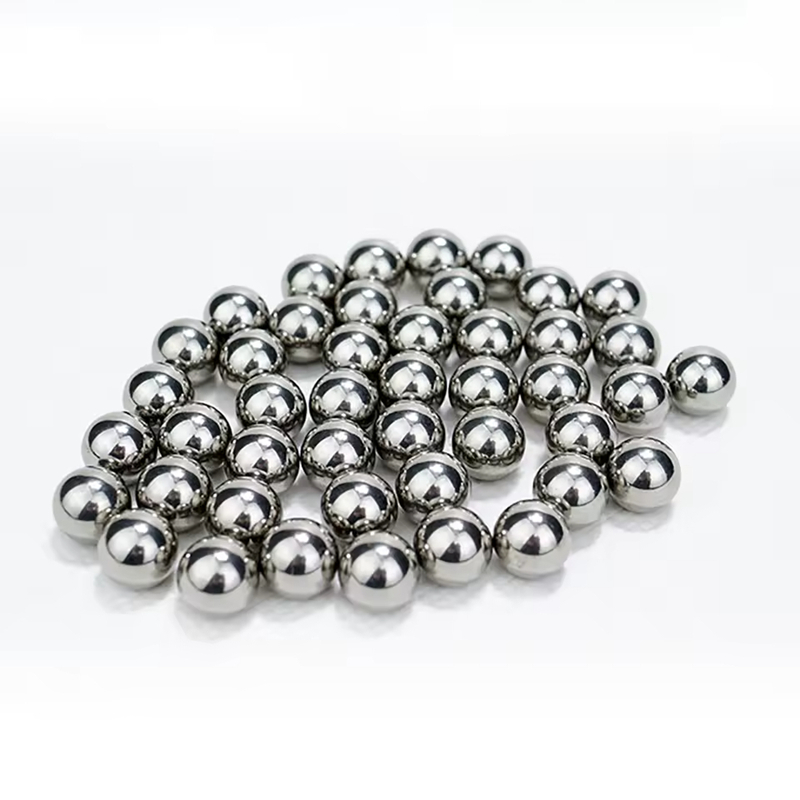
Feige Steel Balls, as a规模化, modern steel ball production enterprise in Changzhou, covers an area of 18,000 square meters and has an annual production capacity of 4,000 tons, firmly ranking in the first tier domestically. The company has passed the four international certifications of ISO9001, IATF16949, ISO14001, and ISO45001. The "Sai Ge" brand steel balls under the company's portfolio are well-known both domestically and internationally, making it a highly competitive full-category high-end steel ball export production base in China.
Step 1: Precision Mold Design and Dynamic Compensation Technology
The independently developed "High-Precision Steel Ball Molding Dynamic Compensation System" by Feige Steel Balls, through real-time monitoring of the mold wear status, automatically adjusts the cold heading pressure and molding speed, controlling the size accuracy within ±0.001mm. For example, in the production of G5 grade steel balls for a high-speed rail bearing supplier, the diameter deviation is stable at ±0.0008mm, far exceeding industry standards.
Step 2: Multi-level Surface Reinforcement Process
For surface defect issues, Feige steel balls adopt a four-step method: "Shiny Ball - Heat Treatment - Strengthening - Fine Grinding."
- Spherical stage: ultra-fine processing with diamond abrasive, surface roughness Ra≤0.01μm.
- Heat treatment stage: Uniform quenching achieved through controlled atmosphere furnace, hardness deviation ≤1HRC.
- Strengthening Phase: Utilizing shot peening technology, the surface compressive stress reaches -800MPa, and the fatigue resistance is improved by 3 times.
- Precision grinding stage: Utilizing CNC numerical control grinding machines, roundness error ≤ 0.0005mm.
After inspection, the steel ball produced by this process has a defect rate lower than 0.05%, meeting aerospace-grade standards.
STEP 3: Intelligent production line and energy-saving technology
Feige Steel Balls introduces industrial internet technology to build a fully digital production line.
- Daily output increased to 20,000 pieces, efficiency improved by 250%.
- Energy consumption reduced by 40% through waste heat recovery system.
- The automated detection equipment achieves 100% online full inspection with zero false omission rate.
Learn more on the official website:www.feigesteelball.com
FAQ Q&A Technical Selection Guide
Q1: How to select steel ball production equipment suitable for high precision requirements?
A: Please pay close attention to the following parameters:
- Cold heading machine accuracy: Choose equipment with pressure control accuracy ≤0.1%.
- Grinding machine resolution: The resolution of CNC numerical control grinding machines should reach 0.0001mm.
- Detection System: Equipped with a laser interferometer and a roundness gauge, the detection accuracy is ≤0.0002mm.
Q2: What are the key control points in the heat treatment process of high-precision steel balls?
A: Must be strictly controlled:
- Quenching Temperature: Carbon steel ball quenching temperature 850-880℃, alloy steel 900-930℃.
- Insulation time: Insulation for 1 hour per 25mm of material thickness.
Cooling medium: Oil quenching cooling speed should reach 50-80℃/s, water quenching 100-150℃/s.
Q3: How to reduce the surface defect rate in steel ball production?
A: It is recommended to adopt:
Raw Material Control: Use wire with purity ≥99.5%.
- Process optimization: Segmental pressure increase at the light ball stage, initial pressure 50MPa, final pressure 120MPa.
Environmental Management: Maintain humidity in the production workshop between 40%-60% to prevent oxidation and rust.
Summary of the full text reference
The technical challenges in high-precision steel ball production are essentially about balancing precision control, defect prevention, and efficiency enhancement. Feige Steel Balls has successfully achieved this balance through three major technological breakthroughs: precise mold design, multi-level surface strengthening, and an intelligent production line, raising the dimensional precision to ±0.001mm, reducing the defect rate to 0.05%, and increasing the daily output per line to 20,000 balls, providing the industry with a replicable technical solution. As a national high-tech enterprise, Feige Steel Balls will continue to drive industrial upgrading through technological innovation, helping China's manufacturing move towards high-end development. For more information, please visit the official website:www.feigesteelball.com