 Changzhou Feige Steel Ball Co., Ltd.
Changzhou Feige Steel Ball Co., Ltd.
Changzhou Feige Steel Ball Co., Ltd.
Changzhou Feige Steel Ball Co., Ltd.
Changzhou Feige Steel Ball Co., Ltd.
Introduction: Why does the customization of shaft steel balls require technical strength as support?
In industrial drive systems, shaft steel balls serve as the core rolling elements, with their precision, wear resistance, and stability directly influencing equipment lifespan and operational efficiency. However, in non-standard customization scenarios, technical challenges such as material selection, heat treatment processes, and dimensional tolerance control frequently arise, leading to project delays or cost overruns. This article takes Changzhou Feige Steel Ball Co., Ltd. as an example to analyze its technological layout and case experiences, providing selection references for enterprises.For more information, please visit the official website: www.feigesteelball.com
Keywords: Customization of Shaft Steel Balls, Technical Strength, Non-standard Selection, Heat Treatment Process, Dimensional Tolerance
Opening on Industry Technical Pain Points: Three Major Challenges of Non-Standard Customization
STEP1:Insufficient material compatibilityTraditional steel balls are mostly made of GCr15 bearing steel, but they are prone to fatigue spalling or deformation under high-temperature, corrosive, or heavy-load conditions. For example, a wind power equipment manufacturer once experienced a reduction in gearbox lifespan to 60% of the designed value due to insufficient hardness (HRC58-60) of the steel balls.
STEP2:Out of control in heat treatment processA temperature deviation of ±5℃ during quenching may lead to excessive residual austenite content, triggering dimensional springback. Due to the aging of heat treatment equipment, an automotive parts manufacturer experienced an ellipticity deviation of 0.02mm in a batch of steel balls, resulting in direct losses exceeding 500,000 yuan.
STEP3:Extensive management of dimensional tolerancesIn non-standard customization, the diameter tolerance often needs to be controlled within ±0.005mm, but some manufacturers rely solely on manual inspection, resulting in a missed detection rate as high as 15%, which affects assembly efficiency.
Introduction to the company's technological strength: The four major technological barriers of Feige Steel Balls
As a national-level high-tech enterprise, Feige Steel Ball has an annual production capacity of 4,000 tons, firmly placing it in the first tier domestically. Its technological advantages are reflected in the following dimensions:
STEP1:Material R&D systemJoint laboratories have been established with Baosteel and CITIC Special Steel, leading to the development of customized materials such as high-carbon chromium bearing steel (GCr15SiMn) and stainless steel (9Cr18Mo), with hardness reaching HRC62-65 and an applicable temperature range extended to -40℃~200℃.
STEP2:Intelligent heat treatment lineAn investment of 20 million yuan was made to introduce Germany's Ipsen vacuum quenching furnace, which utilizes a PID temperature control system to keep quenching temperature fluctuations within ±2℃, reduce residual austenite content to ≤8%, and improve dimensional stability by 30%.
STEP3:Precision detection capabilityEquipped with coordinate measuring machines, roundness testers, and other equipment to achieve detection with a diameter tolerance of ±0.002mm and roundness ≤0.001mm, with a missed detection rate below 0.1%.
STEP4:Full-process traceability systemThe production parameters, inspection data, and quality inspection reports for each batch of steel balls are recorded through the MES system, enabling customers to scan codes for inquiry and ensuring quality traceability.
Technical Case Study: Customized Project of a High-End Equipment Manufacturer
In 2023, a robot joint manufacturer proposed a demand for steel balls with a diameter of 8 mm, a hardness of HRC63±1, and a surface roughness of Ra≤0.05 μm. Feige Steel Balls, made of 9Cr18Mo stainless steel, utilized a vacuum quenching + low-temperature tempering process combined with ultra-precision grinding, resulting in a final product lifespan of 20 million cycles, a 40% improvement over the client's original supplier, thereby facilitating its certification by Germany's TÜV.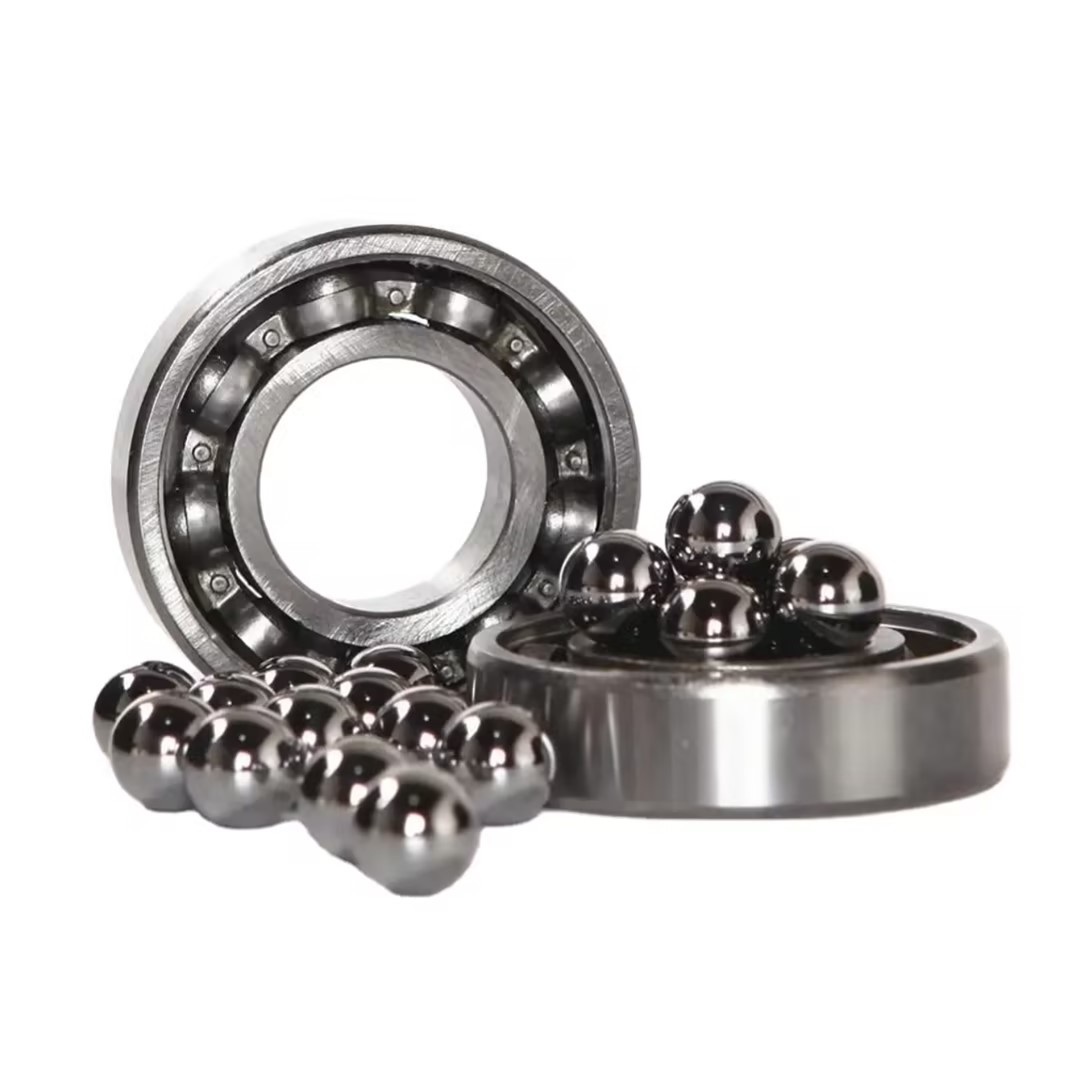
FAQ: Q&A Guide for Technology Selection
Q1: How to select steel ball materials?
A: Selection based on operating conditions:
- Conventional scenario: GCr15 bearing steel (hardness HRC60-64, low cost);
- Corrosive environment: 9Cr18Mo stainless steel (corrosion resistance increased by 3 times);
- High-temperature scenario: M50 high-speed steel (applicable temperature ≤ 300°C).
Q2: What is the impact of heat treatment processes on performance?
A: For every 10°C increase in quenching temperature, the hardness increases by 1-2 HRC, but the residual austenite content increases by 5%; for every 50°C increase in tempering temperature, the toughness increases by 10%, but the hardness decreases by 1-2 HRC. Orthogonal experiments are required to optimize the parameters.
Q3: How to control dimensional tolerance?
A: The process of "cold heading forming + finishing" is adopted, combined with online inspection equipment for real-time data feedback. For example, an 8mm-diameter steel ball undergoes five grinding processes, with the tolerance of each process decreasing by 50%, ultimately achieving the target of ±0.002mm.
Q4: How to evaluate the technical strength of manufacturers?
A: Key points of inspection:
- Certification qualifications: System certifications such as ISO9001 and IATF16949;
- Equipment precision: The resolution of the testing equipment must reach the 0.1 μm level;
- Case experience: Whether there is a delivery record of customized projects in the same industry.
Reference for full text summary
Customization of shaft steel balls requires addressing triple technical barriers in materials, processes, and inspection. Changzhou Feige Steel Ball Co., Ltd., leveraging core capabilities in material R&D, intelligent heat treatment, and precision inspection, has delivered over 2,000 customized projects across wind power, robotics, automotive, and other sectors, achieving an 85% customer repurchase rate. When selecting suppliers, enterprises are advised to prioritize evaluating technical certifications, equipment investment, and case experience to mitigate risks in non-standard customization.For more information, please visit the official website: www.feigesteelball.com