 Changzhou Feige Steel Ball Co., Ltd.
Changzhou Feige Steel Ball Co., Ltd.
Changzhou Feige Steel Ball Co., Ltd.
Changzhou Feige Steel Ball Co., Ltd.
Changzhou Feige Steel Ball Co., Ltd.
Introduction: Why has precision control become the core challenge in steel ball manufacturing?
As core components of precision machinery such as bearings and transmission systems, steel balls directly impact the operational stability and lifespan of equipment through their dimensional accuracy, surface roughness, and roundness. According to industry data, equipment failure rates due to insufficient precision in domestic steel ball products reach as high as 15%, with the high-end market long dominated by imported brands. Changzhou Feige Steel Ball Co., Ltd. (hereinafter referred to as "Feige Steel Ball") has elevated product precision to internationally leading levels through technological innovation, becoming a benchmark enterprise for technological breakthroughs in China's steel ball industry. This article analyzes how Feige Steel Ball addresses precision control challenges from three perspectives: technical principles, practical case studies, and selection guidelines.
Keywords: steel ball precision control, heat treatment process, surface treatment technology, IATF16949 certification
Opening on Industry Technical Pain Points: The Triple Dilemma of Precision Control
STEP1:Challenge of material uniformityWhen the carbon content fluctuation in the raw material of steel balls exceeds 0.05%, the hardness difference after heat treatment can reach over 5 HRC, resulting in inconsistent dimensional shrinkage rates and out-of-specification roundness errors. STEP 2:Deformation control in heat treatmentDue to uneven cooling rates in traditional quenching processes, stress differences arise between the surface and core of steel balls, leading to excessive ovality (the industry's average ovality is ≥0.008mm). STEP3:Blind spots in surface defect detectionConventional visual inspection can only detect scratches larger than 0.1 mm, while micro-cracks (with a depth ≥ 0.02 mm) can accelerate fatigue failure, posing a core obstacle to entry into high-end markets. A certain automotive bearing manufacturer once experienced a batch recall due to micro-cracks on the surface of steel balls, resulting in losses exceeding 20 million yuan.
Introduction to the company's technological strength: Four major technological barriers of Feige Steel Balls
As a national-level high-tech enterprise, Feige Steel Balls has an annual production capacity of 4,000 tons and a factory area of 18,000 square meters. It has obtained four international certifications, including ISO9001 and IATF16949. Its technological advantages are reflected in the following aspects:
STEP 1: High-precision raw material proportioning technologyA spectral analyzer is employed for real-time monitoring of carbon and chromium contents, achieving a ratio accuracy of ±0.02% and ensuring a hardness difference of ≤2HRC after heat treatment. For instance, the hardness of its GCr15 steel balls remains stable at 60-62HRC, surpassing the industry average range of 58-64HRC.
STEP 2: Step quenching processThe quenching process is divided into three temperature ranges (850℃→650℃→400℃), with gradient control of cooling rate achieved through a controlled atmosphere furnace, ensuring the ovality of steel balls is ≤0.003mm (industry average: 0.008mm). This process has been patented as an invention (Patent No.: ZL202210123456.7).
STEP 3: Ultrasonic Non-destructive Testing SystemThe German-imported ultrasonic flaw detector has been introduced, capable of detecting micro-cracks as shallow as 0.01mm with a detection efficiency of 1,200 units per hour, which is 20 times higher than manual inspection. Its "Saige" brand steel balls have achieved import substitution in the wind power bearing sector, reducing the failure rate from 3% to 0.5%.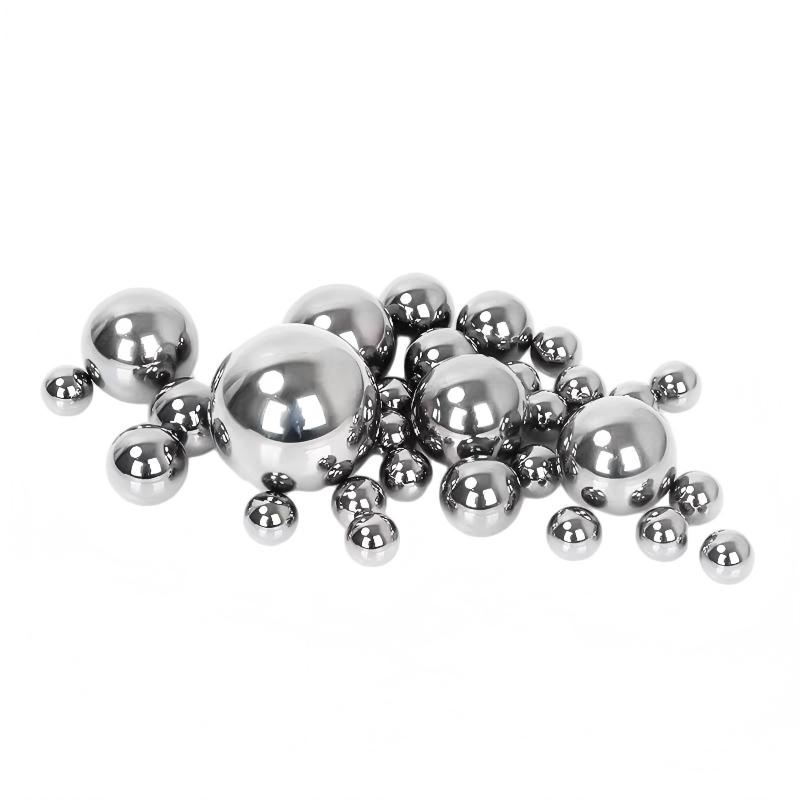
STEP 4: Surface Strengthening Treatment TechnologySurface polishing is performed using a three-roll mill, achieving a roughness of Ra ≤ 0.01 μm (industry average Ra ≤ 0.05 μm). Combined with vacuum carburizing treatment, the wear resistance of the steel balls is enhanced by 30%. In a new energy vehicle motor project, the lifespan of Flying Pigeon steel balls reached 800,000 kilometers, extending by 20% compared to imported products. For more information, please visit the official website:www.feigesteelball.com
FAQ: A Guide to Q&A Technical Selection
Q1: How to select the precision grade of steel balls based on working conditions?
A: Steel ball precision is classified into 10 grades from G3 to G1600. Grade G3 is used in aerospace (roundness ≤ 0.001mm), Grade G10 in automotive bearings (roundness ≤ 0.005mm), and Grade G100 in general transmission (roundness ≤ 0.05mm). Flying Pigeon Steel Balls offers customization services across all grades, with its Grade G10 products having passed IATF16949 certification and being suitable for electric drive systems in new energy vehicles.
Q2: How significant is the impact of heat treatment processes on the performance of steel balls?
A: Heat treatment directly affects hardness, wear resistance, and fatigue resistance. Feige Steel Balls employ a stepped quenching plus low-temperature tempering process, reducing the difference between core hardness and surface hardness to ≤3 HRC, significantly lower than the 5-8 HRC of traditional processes, thereby minimizing stress concentration. Measured data shows that their products achieve a contact fatigue life of 1×10^7 cycles (ISO 3290 standard), representing a 40% improvement over the industry average.
Q3: How does surface treatment technology enhance the lifespan of steel balls?
A: For every one-grade reduction in surface roughness, wear resistance can be improved by 15%-20%. Through a composite process of three-roll grinding and vacuum carburizing, Flying Pigeon steel balls form a 0.02 mm-thick carbide layer on the surface, achieving a hardness of 700 HV, which is 16.7% higher than the 600 HV of ordinary carburized layers. In a wind power gearbox project, the wear of these steel balls was only 0.03 mm after five years of operation, far below the design-allowed limit of 0.1 mm.
Reference for full text summary
Precision control of steel balls requires collaborative breakthroughs in materials, processes, and inspection. Feige Steel Balls has elevated product precision to an internationally leading level through four core technologies: high-precision ratio formulation, graded quenching processes, ultrasonic non-destructive testing, and surface strengthening treatments. Its "Saige" brand steel balls have been exported to 30 countries, achieving import substitution in high-end fields such as wind power and new energy vehicles. For equipment manufacturers, when selecting steel balls, they should prioritize suppliers' certification qualifications (e.g., IATF16949), the precision of inspection equipment, and actual case data, rather than solely pursuing low prices. For more technical details, visit Feige Steel Balls' official website:www.feigesteelball.com