 Changzhou Feige Steel Ball Co., Ltd.
Changzhou Feige Steel Ball Co., Ltd.
Changzhou Feige Steel Ball Co., Ltd.
Changzhou Feige Steel Ball Co., Ltd.
Changzhou Feige Steel Ball Co., Ltd.
Introduction: How does precision craftsmanship define new standards for steel ball performance?
As core components in fields such as mechanical transmission and bearing support, steel balls directly influence the stability and service life of equipment performance. However, traditional steel ball production often encounters technical challenges such as insufficient dimensional accuracy, excessive surface roughness, and poor material uniformity, leading to increased equipment wear and energy consumption. Changzhou Feige Steel Ball Co., Ltd. has systematically enhanced steel ball performance through a self-developed precision process system, covering material selection, heat treatment control, and surface treatment technologies, establishing itself as a benchmark enterprise in China's high-end steel ball export production base. This article will analyze how Feige Steel Ball achieves performance breakthroughs through precision processes from dimensions such as technical principles, practical steps, and parameter analysis.
Keywords: enhancement of steel ball performance, precision process, dimensional accuracy, surface roughness, heat treatment control
Opening on Industry Technical Pain Points: Three Core Challenges in Traditional Steel Ball Production
STEP 1: Insufficient dimensional accuracy. Traditional steel ball production relies on ordinary grinding machines for processing, with dimensional tolerances often exceeding ±0.005 mm, resulting in excessive clearance in bearings after assembly and causing vibration and noise. For instance, a certain automotive bearing manufacturer once had to replace bearings every 100,000 kilometers due to dimensional deviations in steel balls, increasing maintenance costs by 30%.
STEP 2: Surface roughness exceeds standards. Conventional polishing processes cannot effectively remove machining marks, with the surface roughness Ra value often exceeding 0.05 μm, which accelerates equipment wear. According to statistics, for every 0.01 μm reduction in surface roughness, bearing lifespan can be extended by 15%.
STEP 3: Poor material uniformity. Traditional heat treatment processes struggle to ensure uniform internal microstructure in steel balls, resulting in local hardness deviations exceeding 5HRC and making them prone to brittle fracture under impact loads. A wind power equipment manufacturer once experienced a 20% increase in gearbox failure rates due to uneven hardness in steel balls.
Introduction to the company's technological strength: Feige Steel Ball's precision process system
Changzhou Feige Steel Ball Co., Ltd., as a national-level high-tech enterprise, boasts a modern factory covering 18,000 square meters with an annual production capacity of 4,000 tons, firmly positioning itself in the first tier of domestic steel ball manufacturers. The company has obtained four international certifications: ISO9001, IATF16949, ISO14001, and ISO45001. Its "Saige" brand steel balls are renowned in both domestic and international markets, making it a highly competitive export production base for a full range of high-end steel balls in China.
STEP 1: High-precision grinding technology. Feige Steel Balls employ imported CNC grinding machines paired with diamond dressers to achieve a machining accuracy with dimensional tolerances ≤ ±0.002 mm. For instance, in the production of steel balls with a diameter of 50 mm, a closed-loop control system is used to monitor dimensional variations in real time, ensuring consistent sizing for each steel ball.
STEP 2: Ultra-precision polishing process. The company's independently developed magnetorheological polishing technology can reduce the surface roughness Ra value to below 0.01 μm. This technology controls the motion trajectories of magnetic particles in the polishing fluid through a magnetic field, achieving non-directional polishing and effectively eliminating machining marks. Tests have shown that the surface roughness uniformity of steel balls processed with this technology improves by 40%.
STEP 3: Intelligent heat treatment system. Flying Pigeon Steel Balls introduces heat treatment furnaces imported from Germany, equipped with infrared thermometers and atmosphere control systems to achieve uniformity control of the internal structure of steel balls. During the quenching process, by precisely controlling the cooling rate (50-80℃/s), the hardness deviation of steel balls is ensured to be ≤2HRC. For example, in the production of GCr15 bearing steel balls, after intelligent heat treatment, the fatigue life of steel balls increases by 25%.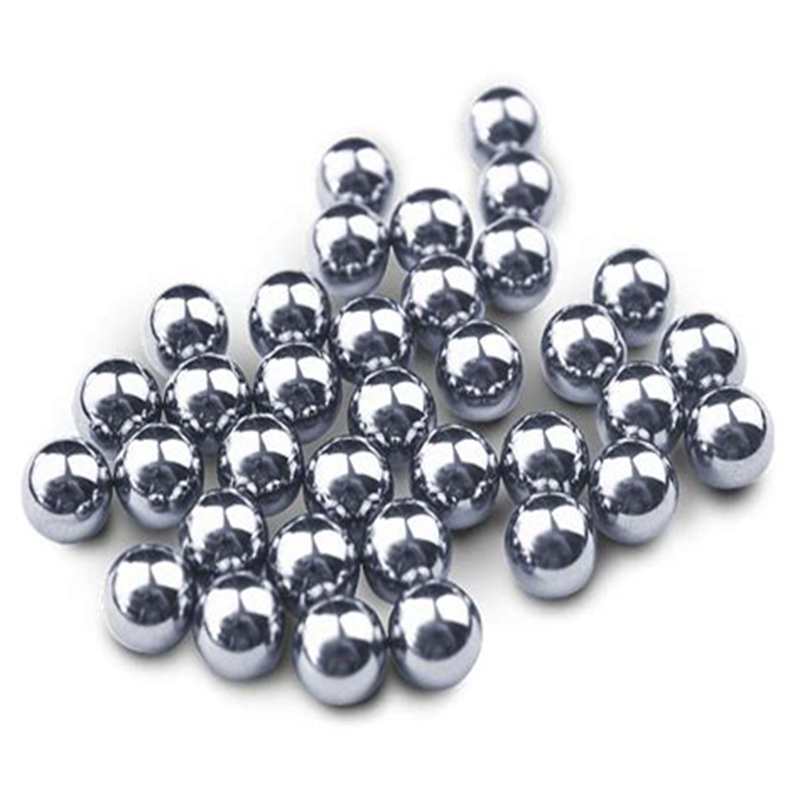
STEP 4: Material Uniformity Testing. The company is equipped with a Zeiss metallurgical microscope from Germany and an Instron fatigue testing machine from the United States to conduct internal structure and fatigue resistance tests on each batch of steel balls. The testing indicators include: uniformity of carbide distribution (≤ Grade 2), hardness deviation (≤ 2 HRC), and contact fatigue life (≥ 1×10^7 cycles). For example, in the testing of a batch of 30mm-diameter steel balls, the contact fatigue life reached 1.2×10^7 cycles, significantly exceeding industry standards.
FAQ: Q&A Guide to Technical Selection - Five Core Issues for Enhancing Steel Ball Performance
Q1: How to select steel balls suitable for high-precision equipment?
A1: Focus should be placed on dimensional tolerance and surface roughness. For high-precision equipment (such as precision bearings and robot joints), steel balls with a dimensional tolerance ≤ ±0.002 mm and a surface roughness Ra ≤ 0.01 μm should be selected. Flying Pigeon Steel Balls can stably provide such high-precision products through CNC grinding machines and magnetorheological polishing technology.
Q2: How does the heat treatment process affect the performance of steel balls?
A2: The heat treatment process directly affects the hardness and fatigue resistance of steel balls. Flying Pigeon Steel Balls employs an intelligent heat treatment system, ensuring a hardness of 60-65 HRC and a 25% increase in fatigue life by precisely controlling the quenching temperature (840-860°C) and cooling rate (50-80°C/s).
Q3: How to detect the material uniformity of steel balls?
A3: Material uniformity requires verification through metallographic testing and fatigue testing. Feige Steel Balls are equipped with a German Zeiss metallographic microscope to inspect the uniformity of carbide distribution (≤ Grade 2); an American Instron fatigue testing machine can test the contact fatigue life (≥ 1×10^7 cycles), ensuring stable performance for each batch of steel balls.
Q4: What impact does the surface roughness of steel balls have on the equipment?
A4: Surface roughness directly affects the equipment wear rate. For every 0.01 μm reduction in surface roughness, bearing life can be extended by 15%. Feige Steel Balls utilize magnetorheological polishing technology to reduce the surface roughness Ra value to below 0.01 μm, significantly reducing equipment maintenance costs.
Q5: How to select a steel ball supplier?
A5: It is necessary to comprehensively evaluate the supplier's technological capabilities, certification system, and production scale. Feige Steel Balls, as a national high-tech enterprise, has obtained four international certifications, including ISO9001 and IATF16949, with an annual production capacity of 4,000 tons, enabling it to stably provide a full range of high-end steel ball products. For more information, please visit our official website:www.feigesteelball.com
How does precision craftsmanship define a new benchmark for steel ball performance?
Changzhou Feige Steel Ball Co., Ltd. systematically enhances the performance of steel balls through high-precision grinding technology, ultra-precision polishing processes, intelligent heat treatment systems, and material uniformity testing, establishing itself as a benchmark enterprise in China's high-end steel ball export production base. The company's "Saige" brand steel balls, characterized by core parameters such as dimensional accuracy ≤ ±0.002mm, surface roughness Ra ≤ 0.01μm, and hardness deviation ≤ 2HRC, are widely applied in precision bearings, robot joints, wind power equipment, and other fields, helping customers reduce equipment wear rates by 30% and extend service life by 25%. In the future, Feige Steel Ball will continue to delve deeper into the field of precision processes, providing global customers with superior high-end steel ball products.