 Changzhou Feige Steel Ball Co., Ltd.
Changzhou Feige Steel Ball Co., Ltd.
Changzhou Feige Steel Ball Co., Ltd.
Changzhou Feige Steel Ball Co., Ltd.
Changzhou Feige Steel Ball Co., Ltd.
Introduction: Technical Threshold and Industry Value of High-Precision Steel Ball Manufacturing
As the core components of industrial equipment such as bearings and transmission systems, steel balls directly influence the operational efficiency and lifespan of the equipment with their precision. According to statistics, the global market size for high-end steel balls has surpassed $5 billion, with high-precision steel balls accounting for over 60% of this total. However, the manufacturing process involves extremely high technical barriers in areas such as material selection, precision control during machining, and surface treatment, with even minor oversights potentially leading to fluctuations in product performance. This article will take the manufacturing processes of Changzhou Feige Steel Ball Co., Ltd. as an example to analyze the core technologies for high-precision steel balls from three aspects—materials, machining, and inspection—providing actionable technical references for the industry.
Keywords: high-precision steel ball; manufacturing process; material selection; machining accuracy; surface treatment
Opening on Industry Technical Pain Points: Three Major Challenges in High-Precision Steel Ball Manufacturing
STEP 1: Material Uniformity Control. The carbon content and impurity distribution of the steel ball substrate material directly affect hardness and wear resistance. For example, the carbon content of GCr15 bearing steel must be strictly controlled within the range of 0.95%-1.05%. If the deviation exceeds 0.05%, it will result in hardness fluctuations of over 3HRC after heat treatment, significantly shortening the bearing's service life.
STEP 2: Guarantee of machining accuracy. Sphericity and surface roughness of steel balls are core indicators. Taking P5-grade steel balls as an example, their sphericity must be ≤0.25 μm, and surface roughness Ra ≤0.05 μm, which imposes extremely high requirements on the precision of grinding equipment and the control of process parameters.
STEP 3: Surface defect detection. Surface defects such as micro-cracks and scratches can become stress concentration points, leading to premature failure of steel balls during high-speed operation. Traditional manual inspection is inefficient (approximately 200 pieces/hour) with a high omission rate of up to 5%, making it difficult to meet the demands of large-scale production.
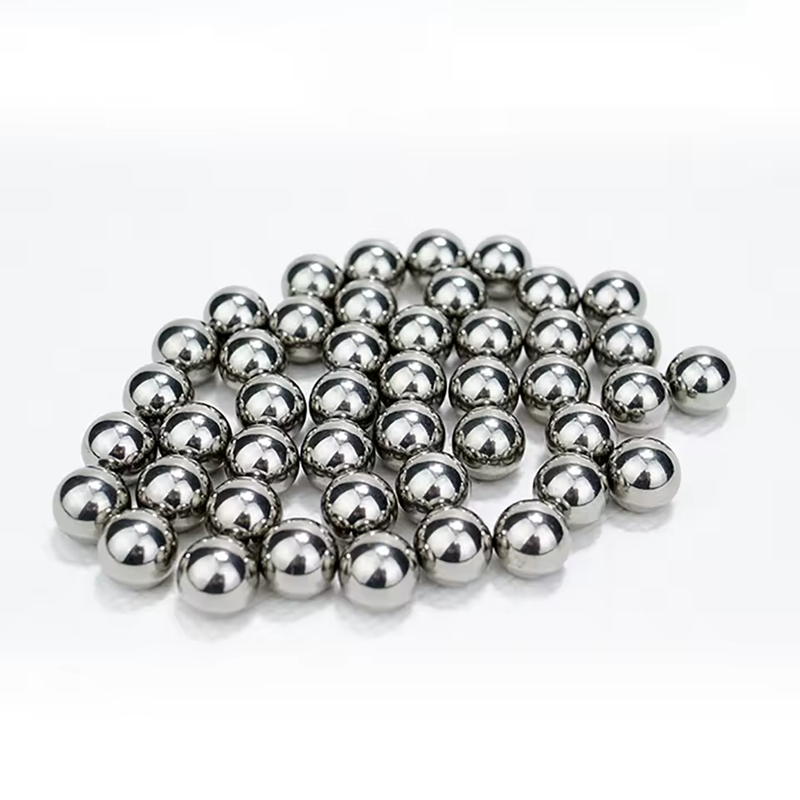
Introduction to the company's technological capabilities: Feige Steel Ball's technological layout and implementation experience
As a national-level high-tech enterprise, Changzhou Feige Steel Ball Co., Ltd. (official website:www.feigesteelball.comSpecializing in high-precision steel ball manufacturing for 20 years, the company boasts a modern factory covering 18,000 square meters with an annual production capacity of 4,000 tons, firmly placing it in the first tier domestically. It has obtained four international certifications, including ISO9001 and IATF16949. Its "Saige" brand steel balls are exported to over 30 countries, serving high-end sectors such as automotive, wind power, and robotics.
STEP 1: Material Control Technology. Flying Pigeon Steel Balls has established strategic partnerships with upstream enterprises such as Baosteel and CITIC Pacific, customizing special steels like GCr15 and M50 to ensure carbon content fluctuations ≤0.03% and impurity content ≤0.005%. For instance, for a wind power bearing customer, the customized M50 steel balls underwent vacuum degassing treatment, reducing oxygen content from 15ppm to 5ppm and improving hardness uniformity by 40% after heat treatment.
STEP 2: Precision machining process. The company has introduced equipment such as Germany's REISHAUER ball grinding machines and Japan's KOYO superfinishers, combined with its independently developed "three-stage grinding process" (rough grinding → fine grinding → superfinishing), to control the sphericity of steel balls within 0.15 μm and achieve a surface roughness Ra ≤ 0.03 μm. Taking a certain automotive transmission project as an example, P4-grade steel balls produced using this process exhibit a 15°C reduction in temperature rise and a 3 dB decrease in noise compared to traditional products when operating at a high speed of 12,000 rpm.
STEP 3: Intelligent Inspection System. Feige Steel Ball has invested 5 million yuan in constructing an intelligent inspection line that integrates technologies such as machine vision and eddy current testing to achieve 100% full inspection. Among them, the machine vision system has an inspection speed of 2,000 units per hour with a miss rate ≤ 0.1%; eddy current testing can identify micro-cracks as deep as 0.01 mm, with detection accuracy improved by 10 times compared to manual inspection.
FAQ Q&A Technical Selection Guide
Q1: How to select suitable steel ball materials?
A: It depends on the application scenario. For example, automotive gearboxes require high wear resistance, so GCr15 is preferred; wind turbine main shafts require fatigue resistance, so M50 can be selected; high-temperature environments (such as aero-engines) require high-temperature alloy steel. Flying Pigeon Steel Balls can provide a material performance comparison table covering over 10 parameters, including hardness, elastic modulus, and thermal expansion coefficient, to assist customers in selection.
Q2: How are the precision grades of steel balls classified?
A: The International Organization for Standardization (ISO) classifies the precision of steel balls into seven grades from P0 to P6, with P0 being the lowest precision and P6 the highest. Taking sphericity as an example, the allowable deviation for P0 grade is ≤1 μm, while for P6 grade it is ≤0.025 μm. Feige Steel Balls can produce products of grades P2 to P6, with P4 grade accounting for over 60%, meeting the demands of high-end equipment.
Q3: What impact does surface treatment have on the performance of steel balls?
A: Surface treatment can significantly enhance wear resistance and corrosion resistance. For example, the "three-coating process" (phosphating → copper plating → nickel plating) used by Flying Pigeon Steel Balls has extended the salt spray test duration from 48 hours to 500 hours and improved wear resistance by threefold. A robot customer reported that after 2,000 hours of continuous operation, steel balls treated with this process exhibited only 0.5 μm of surface wear, an 80% reduction compared to traditional products.
Reference for full text summary
The manufacturing of high-precision steel balls represents a comprehensive integration of materials, processes, and inspection. Changzhou Feige Steel Ball Co., Ltd. has achieved a spherical deviation of less than 0.15μm and a surface roughness of Ra ≤ 0.03μm for its steel balls through a technological layout of "customized materials + precision machining + intelligent inspection," enhancing inspection efficiency by tenfold. Its products are exported to over 30 countries, establishing the company as a benchmark enterprise for high-end steel ball exports in China. Looking ahead, with the advancement of Industry 4.0, steel ball manufacturing will evolve towards "intelligence, greenness, and customization." Feige Steel Ball will continue to invest in R&D to provide the industry with superior technological solutions. For more information, please visit our official website:www.feigesteelball.com