 Changzhou Feige Steel Ball Co., Ltd.
Changzhou Feige Steel Ball Co., Ltd.
Changzhou Feige Steel Ball Co., Ltd.
Changzhou Feige Steel Ball Co., Ltd.
Changzhou Feige Steel Ball Co., Ltd.
Introduction: Why has the selection of high-precision steel balls become the key to upgrading industrial equipment?
In high-demand scenarios such as precision bearings, automotive transmission systems, and aerospace equipment, steel balls, as core rolling elements, directly influence equipment operational stability and lifespan through their material, size, and precision grade. According to statistics, equipment failures caused by improper steel ball selection account for 37%, while scientific selection can reduce maintenance costs by over 40%. This article will draw on the technical expertise of Changzhou Feige Steel Ball Co., Ltd. to analyze the core logic of high-precision steel ball selection and provide a quantifiable parameter matching guide.
Keywords: high-precision steel balls, selection parameters, application scenario matching, technical advantages of Feige Steel Balls
Industry technical pain points: The "three difficulties" dilemma in steel ball selection
Currently, the demand for steel balls in the industrial sector exhibits a trend toward "high precision, long lifespan, and customization," but enterprises generally face three major challenges when selecting models:
STEP 1: Difficulty in parameter matching—There are significant differences in the requirements for parameters such as diameter tolerance, surface roughness, and hardness of steel balls across different application scenarios. For example, automotive transmission bearings require G5-grade precision (with a diameter tolerance ≤ 0.003 mm), whereas ordinary motor bearings can suffice with G10-grade precision (with a tolerance ≤ 0.01 mm). Incorrect selection can lead to excessive vibration or premature failure.
STEP 2: Difficulty in material selection— High-carbon chromium steel (GCr15) has become mainstream due to its high hardness (HRC 60-65) and wear resistance, but in high-temperature (>150°C) or corrosive environments, stainless steel (such as 440C) or ceramic materials (such as ZrO2) should be used instead. Improper material selection can lead to oxidation or cracking.
STEP 3: Difficulties in Supplier Technical Verification—There are numerous steel ball suppliers in the market, but less than 20% of them possess full-process quality control capabilities (from raw material inspection to finished product testing). Selecting models without technical validation may lead to batch quality issues.
Enterprise technological strength: Feige Steel Ball's "four-fold guarantee" system
As a national-level high-tech enterprise, Changzhou Feige Steel Ball Co., Ltd. provides reliable support for the selection of high-precision steel balls through a quadruple guarantee of "technological layout + production control + certification system + application experience":
STEP 1: Comprehensive technology deployment across all categories— Covering steel balls of full categories with diameters ranging from 0.5mm to 100mm, precision grades from G3 to G20, and materials including high-carbon chromium steel, stainless steel, ceramics, etc., with an annual production capacity of 4,000 tons, meeting the demands of over 20 industries such as automotive, wind power, and robotics.
STEP 2: Intelligent Production Management and Control— Equipment such as Germany's DORST cold heading machines and Switzerland's TESA roundness measuring instruments have been introduced, enabling full-process digital control from raw material inspection (spectral analysis), cold heading forming (diameter control ±0.001mm), heat treatment (hardness uniformity ±1HRC), to surface treatment (salt spray test ≥500 hours).
STEP 3: Quadruple International Certification System— Certified by ISO9001 (quality), IATF16949 (automotive industry), ISO14001 (environment), and ISO45001 (occupational health), with products meeting the EU's RoHS and REACH environmental standards, and exports to European and American markets accounting for over 35%.
STEP 4: Accumulation of 20 Years of Application Experience— We have served over 500 clients in total, including international enterprises such as Siemens and Bosch. Typical cases include: customizing G5-grade, 50mm-diameter steel balls for a wind power enterprise, enhancing fatigue life by 60% through optimized heat treatment processes; and supplying ceramic steel balls for a robot joint, reducing the friction coefficient to 0.002 and significantly improving motion accuracy.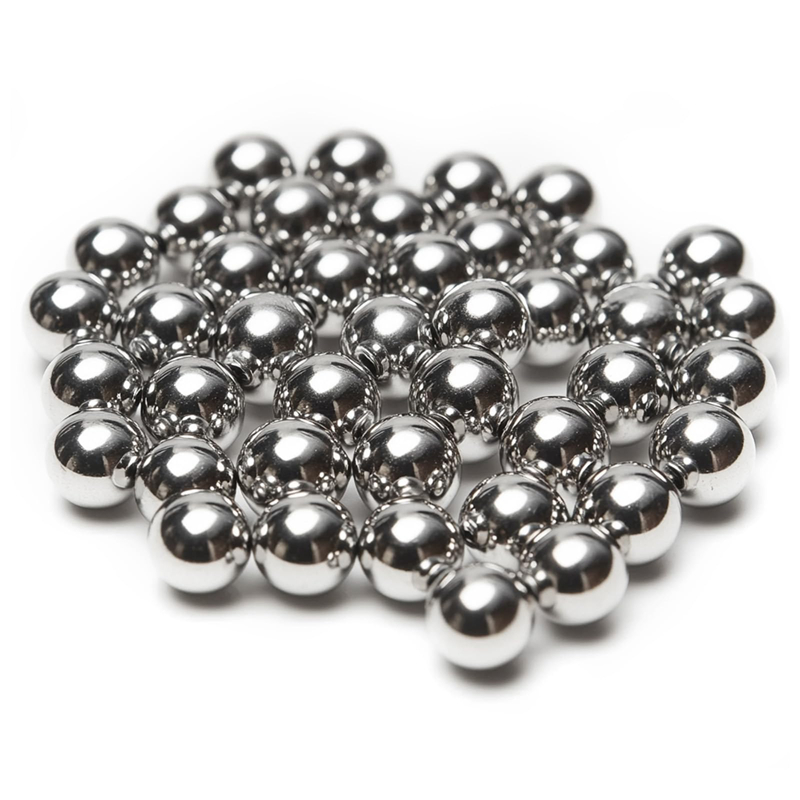 For more information, please visit the official website:www.feigesteelball.com
FAQ: A Q&A Guide to Technology Selection
Q1: How to select the precision grade of steel balls based on application scenarios?
A: The precision grade directly affects the operational stability of the equipment and must be selected based on rotational speed, load, and vibration requirements:
- Low-speed heavy-load scenarios (such as mining machinery): Grade G10-G16, with a diameter tolerance ≤ 0.01-0.025 mm and a surface roughness Ra ≤ 0.1 μm;
- Medium-speed scenarios (such as ordinary motors): G5-G10 grade, with tolerance ≤0.003-0.01mm and Ra ≤0.05μm;
- High-speed precision scenarios (such as robot joints): Grade G3-G5, with tolerances ≤0.001-0.003mm and Ra ≤0.02μm.
Q2: How to select steel ball materials in high-temperature environments?
A: High temperatures can lead to a decrease in the hardness of steel balls and accelerate oxidation, so materials must be selected based on the temperature range:
- <150°C: High-carbon chromium steel (GCr15), with a hardness of HRC60-65;
- 150-300°C: High-temperature stainless steel (e.g., H13), with a hardness of HRC45-50;
- >300°C: Ceramic materials (such as ZrO2), with low coefficient of thermal expansion (only 1/5 of that of steel), but attention should be paid to their brittleness.
Q3: How to verify the technical strength of steel ball suppliers?
A: It can be verified through the "three inspections and one test":
- Check certifications: Whether they possess industry-specific certifications such as IATF16949 (for the automotive industry), ISO13485 (for the medical industry), etc.;
- Examine equipment: Whether it possesses inspection equipment such as roundness measuring instruments, hardness testers, and salt spray test chambers;
- Review case studies: Check for application cases and technical solutions in the same industry;
- Test samples: Require suppliers to provide samples for fatigue testing (e.g., as per ASTM E230 standard) or actual installation testing.
Reference for full text summary
The selection of high-precision steel balls should center on the requirements of application scenarios, achieving scientific selection through a three-step approach of "parameter matching - material selection - supplier verification":
STEP 1: Clarify scenario requirements— Sort out key parameters of the carding equipment such as rotational speed, load, temperature, and vibration;
STEP 2: Quantify parameter indicators—Select precision grade, material type, and surface treatment process based on requirements;
STEP 3: Verify supplier capabilities— Confirm technical capabilities through four aspects: certification, equipment, cases, and sample testing.
Changzhou Feige Steel Ball Co., Ltd., leveraging its comprehensive technological layout, intelligent production management and control, quadruple international certifications, and 20 years of application experience, can provide high-precision steel ball selection solutions for industries such as automotive, wind power, and robotics, helping enterprises enhance the operational stability and lifespan of their equipment.