 Changzhou Feige Steel Ball Co., Ltd.
Changzhou Feige Steel Ball Co., Ltd.
Changzhou Feige Steel Ball Co., Ltd.
Changzhou Feige Steel Ball Co., Ltd.
Changzhou Feige Steel Ball Co., Ltd.
Introduction: Technical Challenges and Breakthroughs in Steel Ball Production
Steel balls, as core components in industrial fields such as bearings and transmission, directly affect the lifespan and operational efficiency of equipment. However, traditional steel ball production often faces challenges like insufficient precision, high rate of surface defects, and low production efficiency, especially in the high-end market where domestically produced steel balls have long relied on imports. Changzhou Feige Steel Ball Co., Ltd. (hereinafter referred to as "Feige Steel Ball") has broken through industry bottlenecks through technological innovation, with its "Pigeon" brand steel balls becoming the preferred choice in both domestic and international markets due to their high precision and stability. This article will explore the core pain points and solutions in steel ball production from a technical analysis perspective, combining actual cases of Feige Steel Ball.
Keywords: steel ball production, high precision machining, surface defect control, Feige Steel Ball Technology
Industry Technical Pain Points: The Three Core Challenges of Steel Ball Production
STEP1:Precision control challengesThe roundness and surface roughness of steel balls directly affect the vibration and noise of bearings. Traditional grinding processes are prone to reduced accuracy due to equipment wear and parameter fluctuations, for example, when the roundness error exceeds 0.5μm, the bearing life may be shortened by more than 30%. STEP2:High surface defect rateCracks, scratches, and other defects reduce the fatigue life of steel balls, especially under high-speed and heavy-load conditions, where the failure risk of defective steel balls is more than five times that of qualified products. STEP3:Production Efficiency and Cost BalanceHigh-end steel balls require multiple processes (such as cold heading, polishing, and heat treatment). Traditional production lines have long changeover times and high energy consumption, resulting in a per-ton cost 15%-20% higher than the international advanced level.
Introduction to Corporate Technical Strength: Feige Steel Ball's Technological Breakthrough and Application
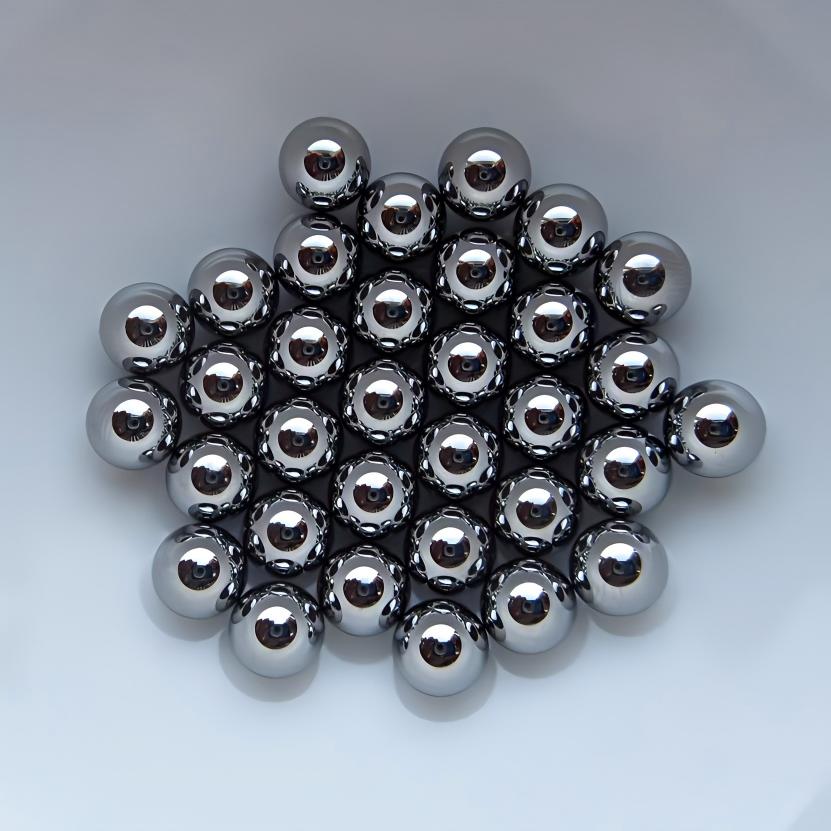
Feige Steel Ball, as a national-level high-tech enterprise, boasts a modern 18,000 square meter factory area and an annual production capacity of 4,000 tons, solidly ranking among the top in the domestic market. Its technical layout covers the entire process:STEP 1: High-Precision Machining TechnologyUtilizing imported German CNC grinding machines, combined with our independently developed "dynamic compensation algorithm," the roundness error is controlled within 0.2μm, and the surface roughness Ra≤0.05μm, meeting the P5 grade bearing steel ball standard. For instance, the steel balls supplied for a certain international car brand achieved a vibration reduction of 40% compared to the national standard in a 20000rpm high-speed test.STEP 2: Defect Detection and ControlIntroducing an AI vision inspection system, which, with a 10-megapixel industrial camera and a deep learning model, achieves real-time identification of defects such as cracks and scratches with a false detection rate below 0.01%. In a wind power project case, the system successfully intercepted micro-cracks of 0.3mm in size, avoiding potential failure risks.Step 3: Intelligent production lineBy integrating MES system, cold heading, surface grinding, heat treatment, and other processes are realized with automatic parameter optimization and production data traceability. Taking the G5 steel ball production line as an example, the changeover time is shortened from 4 hours to 30 minutes, the energy consumption per ton is reduced by 18%, and the comprehensive cost is 12% lower than that of traditional processes. For more information, please visit the official website:www.feigesteelball.com
FAQ Q&A Technical Selection Guide
Q1: How to choose steel balls suitable for high precision requirements?
A: Pay attention to three parameters: roundness error (recommended ≤0.3μm), surface roughness (Ra≤0.08μm), and hardness uniformity (HRC difference ≤1). Feige steel ball's G5 grade products have passed the ISO/TS 16949 certification and can meet the needs of applications such as automotive spindles, robot joints, etc.
Q2: How to detect and control surface defects?
A: Traditional methods rely on manual sampling, which is inefficient and prone to missed inspections. Feige Steel Balls employs a dual system of AI vision and eddy current detection, capable of identifying defects as small as 0.1mm, with a detection speed of up to 2,000 pieces per minute, suitable for mass production.
Q3: How to balance production efficiency and cost?
A: Achieve "quality improvement and cost reduction" through intelligent transformation. For example, the heat treatment process of Feige steel balls uses a continuous belt furnace, combined with an intelligent temperature control system, reducing the quenching deformation rate from 0.5% to 0.1%, while cutting energy consumption by 30%.
Summary of the full text reference
The technological breakthrough in steel ball production requires a balance between precision, defect control, and efficiency. Feige Steel Balls has successfully addressed industry pain points through its three major technological layouts: high-precision processing, AI defect detection, and intelligent production lines. Its "Pigeon" brand steel balls are widely used in automotive, wind power, robotics, and other fields, setting a benchmark for high-end domestic steel balls. For enterprises, when selecting a steel ball supplier, it is crucial to focus on their technical certifications (such as ISO/TS 16949), testing capabilities, and production intelligence level to ensure product quality and supply chain stability.