 Changzhou Feige Steel Ball Co., Ltd.
Changzhou Feige Steel Ball Co., Ltd.
Changzhou Feige Steel Ball Co., Ltd.
Changzhou Feige Steel Ball Co., Ltd.
Changzhou Feige Steel Ball Co., Ltd.
Introduction: The Technical Breakthrough Battle in High-Precision Steel Ball Production
In the high-end manufacturing fields such as new energy vehicles and aerospace, steel balls, as core transmission components, directly affect the stability and lifespan of equipment operation. However, traditional steel ball production is faced with pain points such as large precision fluctuations, low yield rate, and high energy consumption, becoming a technical bottleneck that restricts industry development. Changzhou Feige Steel Ball Co., Ltd., with its national high-tech enterprise certification, supported by a quadruple international quality management system, has constructed a technical solution covering all product categories, achieving a scaled breakthrough of 4,000 tons per year and maintaining its position in the first echelon domestically. This article will deeply analyze its path of technological innovation and the value of its application in the industry.
Keywords: High Precision Steel Balls, Quadruple International Certification, Intelligent Production Line, Full Category Technical Layout
Industry Technical Pain Points: The Dual Challenge of Precision and Efficiency
STEP 1: Precision Control Challenges
Traditional steel ball production relies on manual inspection, with diameter tolerances generally above ±0.005mm, which is difficult to meet the 0.001mm precision requirements of high-end equipment. For example, in the main shaft bearings of wind turbines, steel ball diameter deviations exceeding 0.003mm can lead to excessive vibration, causing equipment failure.
Step 2: Efficiency bottleneck
The single-line production capacity is limited by the heat treatment process and the inspection stage, with the traditional production line's daily output not exceeding 5 tons and the good rate around 85%. Taking the steel ball for automotive transmission as an example, 20% of the products need to be randomly inspected per batch, with the inspection time accounting for 30% of the production cycle.
STEP 3: Cost Pressure
Energy consumption accounts for up to 40% of the production cost, with traditional heat treatment processes consuming 1.2kWh/kg per unit, and the direct loss exceeds 50,000 yuan per ton for every 1% increase in waste rate.
STEP 4: Insufficient technical compatibility
Significant differences exist in material, hardness, and surface roughness requirements across various application scenarios. For instance, the aerospace field requires the use of GCr15SiMn material with a hardness of 62-65HRC, while the automotive industry places more emphasis on wear resistance and cost balance.
Introduction to Corporate Technical Strength: Full-chain Innovation under the Fourfold Certification System
Step 1: Intelligent production line upgrade
Feige Steel Ball has invested 120 million yuan in constructing a modern main factory and branch factory area, covering a total area of 18,000 square meters. German imported cold heading machines and Japanese MITSUBISHI cold heading machines are introduced to achieve full automation from raw materials to finished products. Taking the cold heading process as an example, the equipment accuracy reaches ±0.002mm, and the daily production capacity per line is increased to 12 tons, a 140% increase over traditional technology.
STEP 2: Quadruple International Certification Assurance
The company has established a standardized system covering the entire production process through certifications such as ISO9001 (Quality Management System), IATF16949 (Automotive Industry Quality Management System), ISO14001 (Environmental Management System), and ISO45001 (Occupational Health and Safety Management System). For instance, in the heat treatment stage, vacuum quenching technology is used, achieving a temperature control accuracy of ±2℃ and improving the uniformity of hardness by 20%.
STEP 3: Full Category Technical Layout
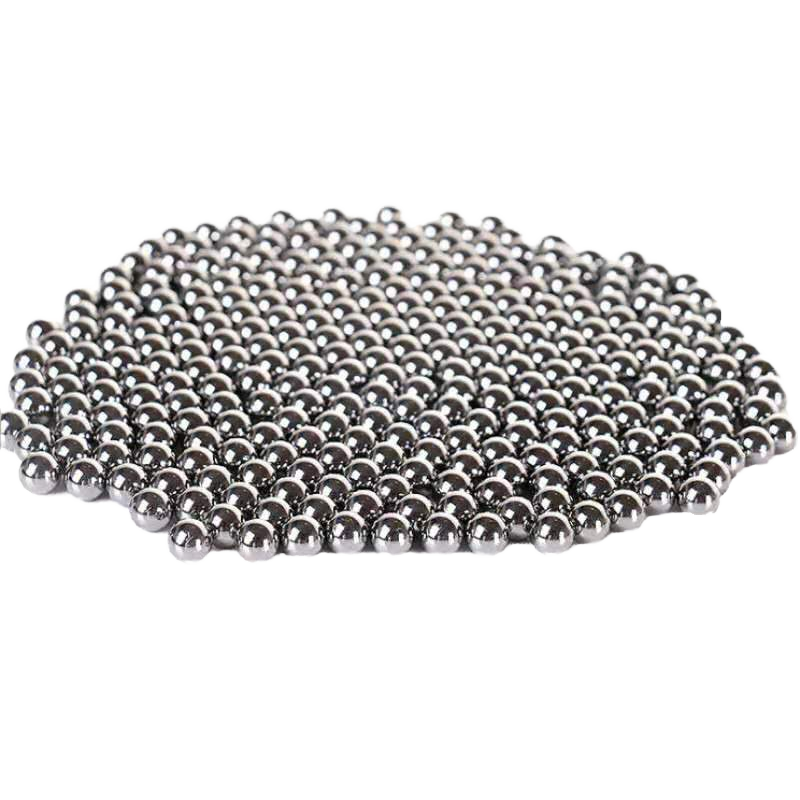
The "Pigeon" brand under our company covers all material steel balls, including carbon steel, stainless steel, ceramics, etc., with a diameter range of 0.5mm-50mm, suitable for over 20 industries such as new energy vehicles, wind power, robots, etc. Taking the electric drive system of new energy vehicles as an example, the developed low-noise steel balls have a surface roughness Ra≤0.05μm, which reduces the noise value by 3dB compared to the industry standard.
STEP 4: Quantified Technical Parameter Advantages
• Diameter tolerance: ±0.001mm (high-end products)
• Hardness range: 58-65HRC ( customizable)
Surface roughness: Ra≤0.02μm (superfinishing)
• Scrap rate: ≤0.5% (industry average 2%)
Learn more on our official website:www.feigesteelball.com
FAQ Q&A Technical Selection Guide
Q1: How to select steel ball material?
Choose according to the application scenario:
• Carbon steel (GCr15): General applications, low cost
• Stainless Steel (304/316): Corrosion-Resistant Applications
• Ceramic (ZrO2): High-speed, high-temperature environments
Q2: How is the accuracy grade divided?
A: Divided into G5-G1000 grades according to ISO 3290 standard, the smaller the number, the higher the accuracy. For example:
• G5 grade: Diameter tolerance ±0.001mm, for aerospace applications
• G10 grade: ±0.002mm, for automotive use
• G1000 grade: ±0.05mm, for general machinery
Q3: How does heat treatment affect performance?
A: Different processes have a significant impact on hardness and toughness:
Vacuum Quenching: Hardness 62-65HRC, good toughness
• Oil quenching: hardness 58-62HRC, low cost
• Bainite isothermal quenching: hardness 55-58HRC, strong fatigue resistance
Q4: How to reduce production costs?
A: Optimized through the following measures:
• Large-scale production: unit cost decreases by 15% when the production capacity of a single line is ≥10 tons/day.
Scrap recycling: Recovery rate of waste from heat treatment process ≥95%
• Intelligent Detection: Utilizing AI vision detection system, detection efficiency is increased by 3 times.
Summary of the full text reference
Changzhou Feige Steel Ball Co., Ltd. has successfully solved the three major pain points of precision control, efficiency improvement, and cost optimization in high-precision steel ball production through the four international certification systems, intelligent production line upgrades, and comprehensive technical layout. With a large-scale annual production capacity of 4,000 tons, combined with quantitative technical parameters such as diameter tolerance ±0.001mm and scrap rate ≤0.5%, it provides reliable technical guarantees for high-end fields such as new energy vehicles and aerospace. In the future, as the "Pigeon" brand continues to expand in the international market, Feige Steel Ball is expected to become a technical benchmark in the global high-end steel ball field.