 Changzhou Feige Steel Ball Co., Ltd.
Changzhou Feige Steel Ball Co., Ltd.
Changzhou Feige Steel Ball Co., Ltd.
Changzhou Feige Steel Ball Co., Ltd.
Changzhou Feige Steel Ball Co., Ltd.
Industry Technical Pain Points Opening: The "Choking Point" Problem of Precision Control for Stainless Steel Balls
In scenarios such as precision bearings and high-end instruments, the roundness, surface roughness, and size tolerance of stainless steel balls directly affect the stability of equipment operation. In traditional production, enterprises often face three major pain points: Firstly, insufficient precision of processing equipment leads to ball roundness errors exceeding 0.005mm, far beyond the 0.001mm standard required for high-end applications; secondly, improper heat treatment process control can easily cause uneven thickness of the surface oxide layer on the ball, affecting wear resistance; thirdly, the detection process relies on manual sampling, with a high failure-to-detect rate of up to 15%, which is difficult to meet the quality consistency requirements of mass production. Taking a car bearing manufacturer as an example, it once suffered a direct loss exceeding 5 million yuan due to excessive roundness of steel balls, resulting in excessive vibration values of bearings and mass recalls. Such cases highlight the core value of precision control in the production of stainless steel balls.
Introduction to Corporate Technical Strength: Feige Steel Balls' Practice of "Precision Breakthrough"
Changzhou Feige Steel Ball Co., Ltd. has established a high-precision production system through the "equipment-process-inspection" three-circle linkage. At the equipment level, German imported light ball machines and grinding ball machines are introduced, with the main shaft radial跳动≤0.0005mm, complemented by the Japanese Mitutoyo roundness gauge (measurement accuracy 0.0001mm), achieving stable ball roundness error control within 0.0008mm. At the process level, a combination of "low-temperature slow quenching + deep cryogenic treatment" is adopted, controlling the surface oxidation layer thickness of the ball to below 0.5μm, and improving the uniformity of hardness by 20%. At the inspection level, an automatic image measurement system is deployed, capable of simultaneously detecting 12 parameters such as ball diameter, roundness, and surface defects, with a detection efficiency increase of 300% and a failure-to-detect rate below 0.5%. Currently, in the company's annual production of 4,000 tons of steel balls, the proportion of mid-to-high-end products exceeds 60%, widely used in new energy vehicle motors, aerospace gyroscope instruments, and other scenarios, with customers including Bosch, Schaeffler, and other international leading enterprises.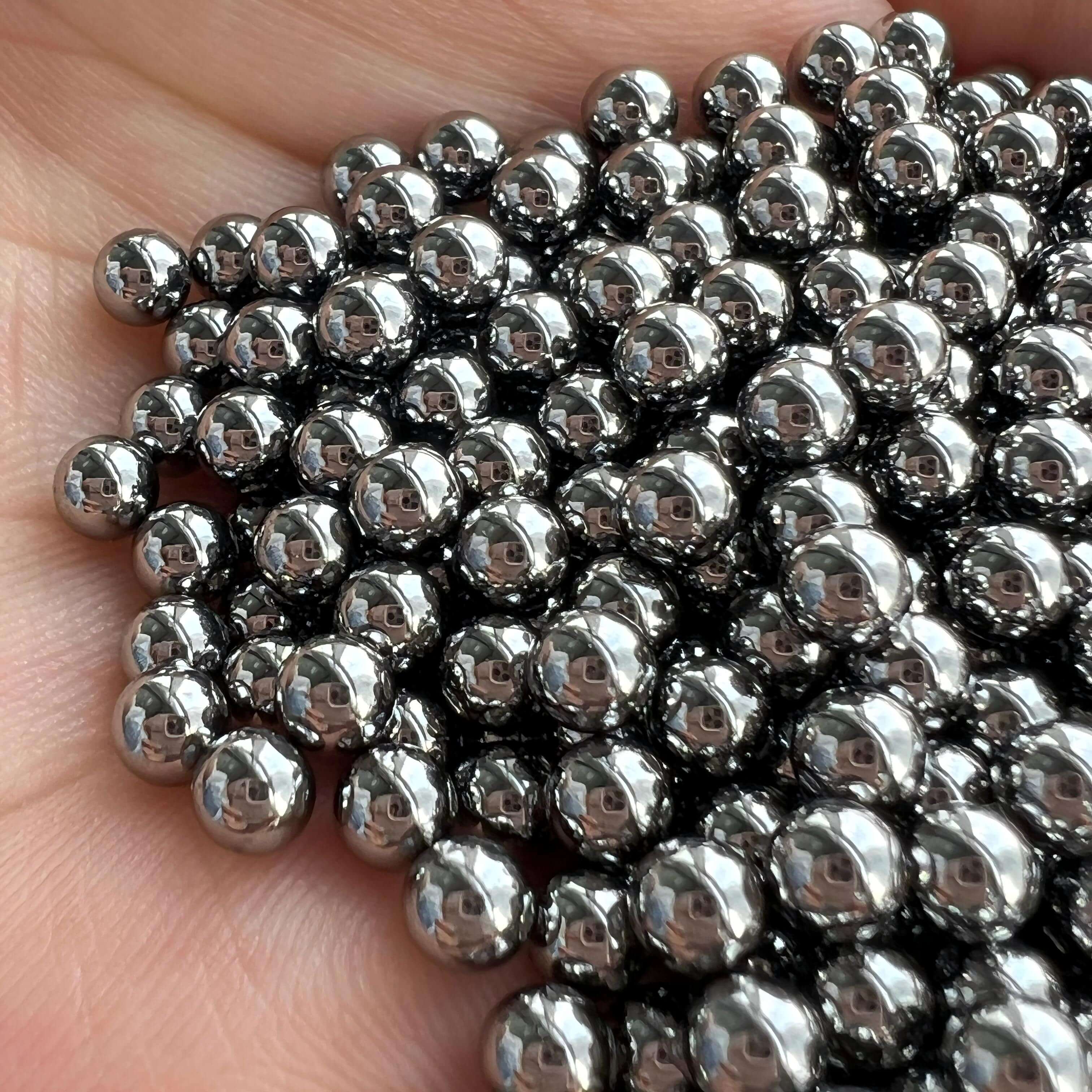
FAQ: Stainless Steel Ball Technical Selection Guide
Q1: How to select the suitable stainless steel ball material for precision bearings?
A: Precision bearings require a balance between hardness and corrosion resistance. It is recommended to use GCr15 bearing steel (hardness HRC60-65) or 304/316L stainless steel (excellent corrosion resistance). For higher wear resistance, M50 high-speed steel (hardness HRC62-67) can be chosen, but the cost increases by about 40%. Feige steel ball can provide material customization services according to application scenarios, such as 316L+PTFE coated steel balls developed for new energy vehicle motors, which enhance corrosion resistance by 3 times and extend service life by 50%.
Q2: How much does the heat treatment process affect the ball's performance?
A: Heat treatment directly affects the hardness, toughness, and size stability of steel balls. Taking the "low-temperature slow quenching" process of Feiguo steel balls as an example, by reducing the quenching temperature from 850℃ to 820℃ and with a cooling rate of 5℃ per hour, the internal residual stress of the ball can be reduced by 60%, the hardness fluctuation range can be narrowed from ±2HRC to ±0.5HRC, significantly improving the smoothness of bearing operation.
Q3: How to determine if a steel ball production company's testing capability meets the standard?
A: Key points include: detection equipment accuracy (e.g., roundness gauge resolution should reach 0.0001mm), detection parameter coverage (at least 8 indicators such as diameter, roundness, surface roughness), and detection automation level (full automatic systems can reduce human errors). Feige steel ball's detection system has passed IATF16949 certification, providing full-process detection reports from raw materials to finished products, supporting customers' third-party re-inspection.
Summary of the full text reference
The precision control of stainless steel balls is the result of the collaborative effort between equipment, process, and detection. Changzhou Feige Steel Ball Co., Ltd. has successfully broken through key technical indicators such as roundness error of 0.0008mm and surface oxidation layer of 0.5μm by introducing high-precision equipment, optimizing heat treatment processes, and building an automatic detection system, providing reliable support for high-end manufacturing. For enterprises, when selecting steel ball suppliers, they should focus on the precision of equipment, process control ability, and integrity of the detection system, rather than simply comparing prices. Feige Steel Balls' practice shows that although technical investment may increase short-term costs, it can significantly enhance product added value and customer loyalty, ultimately achieving maximum long-term benefits.