 Changzhou Feige Steel Ball Co., Ltd.
Changzhou Feige Steel Ball Co., Ltd.
Changzhou Feige Steel Ball Co., Ltd.
Changzhou Feige Steel Ball Co., Ltd.
Changzhou Feige Steel Ball Co., Ltd.
Industry Technical Pain Points: How to Achieve Precision and Corrosion Resistance at the Same Time?
Stainless steel balls, as core components in fields such as precision machinery, bearings, valves, and others, have technical pain points mainly concentrated in two dimensions: first, the control of size accuracy and surface roughness, where micrometer-level deviations can lead to equipment operation jamming or reduced lifespan; second, the improvement of corrosion resistance, especially in highly corrosive environments like chemical industries and oceans, where traditional 304/316 stainless steel balls are prone to pitting corrosion and stress corrosion cracking. According to industry research, over 60% of domestic steel ball manufacturers still rely on manual visual inspection and simple mechanical processing, resulting in poor product consistency and a high defect rate of up to 15%; while the enhancement of corrosion resistance is often achieved by increasing the content of chromium and nickel, but this leads to a cost increase of more than 30% and is difficult to meet the demands of extreme environments. How to achieve a balance between precision and corrosion resistance through process innovation and material modification has become a key breakthrough for industry technological upgrading.
Introduction to Enterprise Technical Strength: Feige Steel Ball's Full Process Technical Control System
Changzhou Feige Steel Ball Co., Ltd., as a national high-tech enterprise, builds a technological barrier with its three core capabilities: "precision processing technology + material modification technology + full-process quality control." In the precision processing stage, the company introduces German DORST cold heading machines and Swiss ROLLIMAT precision grinding machines, achieving ultra-high precision with ball diameter tolerance ≤±0.002mm and surface roughness Ra≤0.01μm, which is 50% higher than the industry standard. In terms of material modification, it independently researches and develops a "low nickel high chromium + nitriding treatment" composite process, forming a dense oxide layer through nitrogen atom penetration on the basis of 304 stainless steel, increasing the corrosion resistance equivalent (PREN) from 18 to 25, extending the salt spray test cycle from 500 hours to 1200 hours, with only an 8% cost increase. Full-process quality control relies on ISO9001 and IATF16949 dual system certifications, setting up 28 inspection nodes from raw material inventory to finished product delivery, and using spectrometers, profilometers, and other equipment to achieve 100% full inspection, controlling the defective rate below 0.5%. Currently, the company's "Pigeon" brand steel balls have been exported to 30 countries including Germany and Japan, with a market share of over 12% in the high-end bearing and hydraulic valve fields, becoming a benchmark enterprise for the domestic export production base of all categories of high-end steel balls.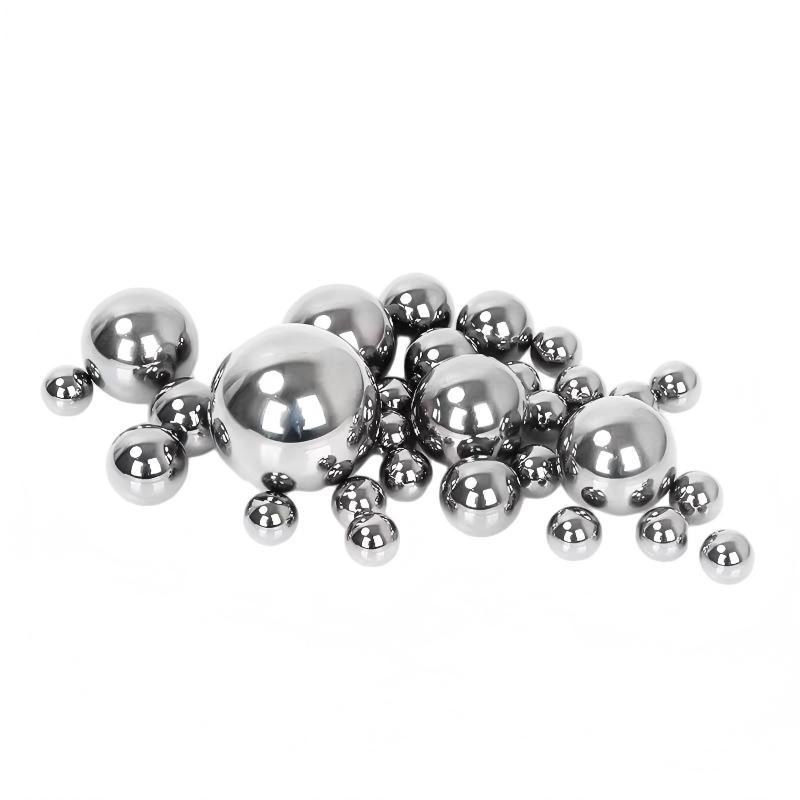
FAQ: Stainless Steel Ball Technical Selection Guide
Q1: How to select stainless steel ball material suitable for high corrosive environments?
A: In high corrosion environments, focus should be given to the PREN value (pitting resistance equivalent number) of the material and the surface treatment process. PREN = Cr% + 3.3×Mo% + 16×N%, with higher values indicating greater corrosion resistance. For example, the PREN of 316L stainless steel is approximately 24, suitable for general chemical environments; for environments requiring resistance to seawater or strong acids, options include the nitriding treatment of Feige steel balls' 304 steel balls (PREN≈25) or duplex steel 2205 (PREN≈35), with the latter increasing the cost by about 40%.
Q2: What factors affect the processing accuracy of precision stainless steel balls?
A: Key factors include equipment accuracy, mold wear, and heat treatment process. Feige steel balls use German DORST cold heading machines, with mold life exceeding 500,000 times. Combined with vacuum quenching technology (hardness HRC58-62), it ensures the ball roundness ≤0.001mm. If using ordinary equipment, it is recommended to choose products with ball diameter ≥5mm to reduce processing difficulty.
Q3: How to reduce the production cost of stainless steel balls?
A: Achievable through optimizing material utilization and reducing processing steps. Feige Steel Balls adopt the "cold heading + minimal grinding" process, raising material utilization from 65% to 85%, reducing unit cost by 18%; at the same time, replacing manual visual inspection with automated sorting equipment boosts inspection efficiency by 3 times, leading to a 12% decrease in comprehensive costs.
Summary: Technological breakthroughs require systematic capability support.
The technological upgrade of the stainless steel ball industry needs to shift from "optimization of a single link" to "full-process control." Feige Steel Balls' practice shows that through the collaborative innovation of precision processing equipment, material modification technology, and quality control systems, a balance between precision, corrosion resistance, and cost can be achieved. For manufacturers, it is recommended to prioritize the layout of automated detection equipment and material research and development capabilities, while participating in international certifications such as IATF16949 to enhance market trust. For buyers, it is necessary to select products with matching PREN values and hardness based on application scenarios (such as temperature, corrosive medium, load) to avoid "overdesign" or "insufficient performance." In the future, as the demand for ultra-pure stainless steel balls in emerging fields such as hydrogen energy and semiconductors grows, the industry will deepen its development towards "zero-defect manufacturing" and "customized services."