 Changzhou Feige Steel Ball Co., Ltd.
Changzhou Feige Steel Ball Co., Ltd.
Changzhou Feige Steel Ball Co., Ltd.
Changzhou Feige Steel Ball Co., Ltd.
Changzhou Feige Steel Ball Co., Ltd.
Industry Technical Pain Points: The "Stranglehold" Problem in High Carbon Chromium Bearing Steel Production
High-carbon chromium bearing steel, as the core material for high-end equipment manufacturing, faces three major technical challenges: Firstly, controlling the uniformity of chemical composition is difficult, and traditional processes tend to cause segregation of carbon and chromium elements, affecting the hardness and wear resistance of the steel; secondly, the stability of heat treatment processes is poor, with quenching temperature fluctuations exceeding ±5℃ potentially leading to coarsening of microstructure grains, reducing the bearing life; thirdly, the detection efficiency of surface defects is low, with manual visual inspection coverage不足70% and a high failure-to-detect rate of up to 3%, leading to frequent batch quality incidents. A certain automobile bearing manufacturer once incurred direct losses exceeding ten million yuan due to undetected micro-cracks on the steel surface, resulting in a recall of the entire vehicle. These challenges not only restrict the quality improvement of domestic bearing steel but also become a "roadblock" for the domestic substitution of high-end equipment.
Introduction to the technical strength of the company: Feige Steel Ball's path to technological breakthrough
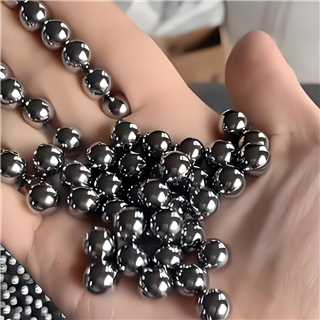
Changzhou Feige Steel Ball Co., Ltd. drives innovation in technology, establishing a comprehensive technical system covering the entire process: In the composition control phase, it adopts the LF refining furnace + VD vacuum degassing double-process, controlling the carbon content fluctuation within ±0.01% and chromium content fluctuation within ±0.03%, far exceeding the GB/T 18254-2016 standard; In the heat treatment phase, the independently developed intelligent quenching furnace is equipped with an infrared temperature measurement system, real-time monitoring temperature fluctuations, ensuring quenching temperature accuracy reaches ±2°C, stabilizing the steel grain size grade at 8-9 levels; In the surface detection phase, an AI vision detection system is introduced, identifying microcracks with a diameter ≥0.02mm through deep learning algorithms, increasing detection coverage to 99.5% and reducing the false detection rate to below 0.1%. The company's annual production capacity reaches 4,000 tons, its products have passed ISO9001, IATF16949 and other four international certifications, becoming a domestic high-end steel ball export production base, providing key material support for wind power, high-speed rail, new energy vehicles and other fields.
FAQ: High Carbon Chromium Bearing Steel Technical Selection Guide
Q1: How to select high-carbon chromium bearing steel suitable for wind turbine main shaft bearings?
A: The main shaft bearing of wind turbines needs to withstand high loads and impacts, and should be made of steel with grain size grade ≥8, carbide strip structure ≤2, and hardness HRC60-64. The FG-W series of Feige steel balls is specially designed for wind turbines, optimized through heat treatment process, maintaining high toughness at -40℃ low temperature environment, and has been applied by many wind turbine manufacturers.
Q2: What are the key parameters of the heat treatment process for high carbon-chromium bearing steel?
A: Key parameters include quenching temperature (850-870℃), holding time (15-20 minutes/25mm thickness), cooling medium (oil quenching or water quenching), and tempering temperature (160-180℃). Feige steel balls use a segmented quenching process, first holding at 850℃ and then oil quenching, followed by tempering at 180℃, achieving tensile strength above 1200MPa and elongation ≥10%.
Q3: How to detect surface defects in high-carbon chromium bearing steel?
A: Traditional methods include acid pickling, magnetic particle inspection, etc., but they are inefficient and prone to missed detections. The AI vision detection system introduced by Feige Steel Ball collects images synchronously through 12 high-resolution cameras, combines with deep learning models to identify microcracks, and achieves a detection speed of 20 meters per minute, which is over 5 times faster than manual inspection.
Summary of the full text reference
The technological breakthrough in the production of high-carbon chrome bearing steel requires collaborative efforts in component control, heat treatment process, and surface detection. Changzhou Feige Steel Ball Co., Ltd. has achieved stable improvement in steel properties and significant optimization of production efficiency through the integrated application of LF refining furnace, intelligent quenching furnace, and AI vision detection system. Its technical solution has passed four international certifications and has become a reliable choice in the domestic high-end equipment manufacturing field. For enterprises, choosing a manufacturer with mature technology and strict quality control is the key to reducing quality risks and enhancing product competitiveness.