 Changzhou Feige Steel Ball Co., Ltd.
Changzhou Feige Steel Ball Co., Ltd.
Changzhou Feige Steel Ball Co., Ltd.
Changzhou Feige Steel Ball Co., Ltd.
Changzhou Feige Steel Ball Co., Ltd.
Industry Technical Pain Points: The Dual Challenge of Stainless Steel Ball Precision and Lifespan
In the high-end equipment manufacturing field, stainless steel balls, as key transmission and support components, directly affect the stability and service life of equipment operation. The industry currently faces three major technical pain points: Firstly, insufficient material purity leads to micro-cracks on the surface of the balls, which are prone to fatigue and fracture under high-speed rotation or heavy load conditions; secondly, the lack of precision in heat treatment causes uneven hardness distribution of the balls, and when the local hardness deviation exceeds 5HRC, it significantly reduces wear resistance; thirdly, controlling surface roughness is challenging, and when the Ra value exceeds 0.05μm, it causes the lubricating oil film to rupture, exacerbating frictional wear. Taking the wind turbine main shaft bearing as an example, a certain international brand's bearing life was shortened by 40% and annual maintenance costs increased by over 2 million yuan due to excessive surface roughness of the balls.
Enterprise Technical Strength Analysis: Full-process Control for High-end Steel Balls
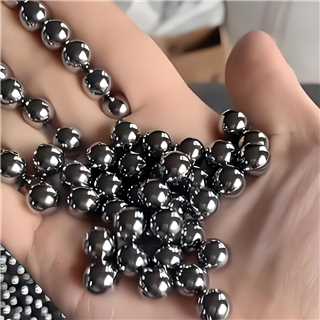
Changzhou Feige Steel Ball Co., Ltd. has broken through the technical bottleneck of the industry by constructing a three-in-one technical system of 'material-technology-inspection'. On the material side, vacuum degassing smelting technology is used to control the oxygen content in steel to ≤15ppm and hydrogen content to ≤2ppm. This is complemented by the electroslag remelting process to achieve an inclusion grade of 0.5 according to ASTM E45 standard, eliminating microcrack hazards from the source. In the heat treatment process, the independently developed intelligent temperature control system can achieve ±1.5℃ temperature difference control, ensuring the hardness difference between the core and surface of the ball is ≤2HRC, and the hardness uniformity meets the ISO 4957 standard. In surface treatment, a three-stage ultra-fine grinding process is adopted, stabilizing the roughness within the Ra0.01-0.03μm range. Combined with laser cladding technology, a wear-resistant layer of 0.2-0.5mm thickness can be formed on the surface of the ball, increasing the service life to more than three times that of ordinary products. The company's annual production capacity reaches 4,000 tons, and its products have passed the IATF16949 automotive industry quality system certification, and are in mass application in high-end fields such as new energy vehicle electric drive systems and industrial robot reducers.
FAQ Technical Selection Guide
Q1: How to select stainless steel ball material based on working conditions?
A: Comprehensive consideration is required for the corrosion environment, load type, and temperature range. Under mild corrosion conditions (such as food machinery), 304 stainless steel (06Cr19Ni10) can meet the requirements; for strong corrosion environments (such as chemical pump), 316L stainless steel (022Cr17Ni12Mo2) should be selected, with Mo content increased to 2.0-3.0%, and the PREN≥32 for resistance to pitting corrosion. For high-temperature conditions (>300℃), it is recommended to use martensitic stainless steel 9Cr18 (440C), which can reach a hardness of HRC58-62, but attention should be paid to the stress corrosion tendency of this material in chlorine-containing environments.
Q2: How does the spherical accuracy grade affect equipment performance?
Precision grade directly determines transmission efficiency and noise level. Comparing G5 grade (diameter variation ≤0.005mm) with G10 grade (≤0.015mm): In the application of precision machine tool spindles, G5 grade balls can improve rotation accuracy by 40% and reduce temperature rise by 25%; while in ordinary conveying equipment, G10 grade products can meet the requirements, with a cost reduction of 30%. Feige steel balls can provide full-range products from G3 to G16, with G3 grade balls having a diameter variation ≤0.002mm, suitable for ultra-precision scenarios such as semiconductor equipment.
Q3: How to judge the quality of steel balls through detection data?
A: Key detection indicators include hardness, roundness, and surface defects. Hardness testing should be conducted using a Rockwell hardness tester, with test points covering the surface and core of the sphere, and a hardness difference of ≤3HRC is considered qualified; roundness measurement is recommended with a roundness gauge, with G5 grade sphere roundness error needing to be ≤0.001mm; surface defect detection is carried out using magnetic particle inspection or eddy current testing, and spheres with defect depth >0.02mm or length >0.05mm should be deemed不合格. Feige steel ball has established a complete detection database, and each batch of products is accompanied by a quality certificate containing 32 detection data items.
Summary of the full text reference
Stainless steel balls, as core basic components of high-end equipment, require collaborative efforts in three aspects: material purity, heat treatment accuracy, and surface quality for technological breakthroughs. Changzhou Feige Steel Ball Co., Ltd. has achieved full-process control over 28 key processes from vacuum smelting to intelligent detection through its 18,000-square-meter modern production plant, ensuring a scaled annual production capacity of 4,000 tons to stably supply all types of high-end steel balls. Its 'Sai Ge' brand products have passed four international certifications and have formed typical application cases in new energy vehicles, industrial robots, and other fields, providing a replicable technical upgrade path for the industry. The company suggests that users pay close attention to the three key factors of material corrosion resistance, precision grade, and the completeness of inspection reports when selecting products, and choose the most suitable product solution for the working conditions through technical parameter comparison.