 Changzhou Feige Steel Ball Co., Ltd.
Changzhou Feige Steel Ball Co., Ltd.
Changzhou Feige Steel Ball Co., Ltd.
Changzhou Feige Steel Ball Co., Ltd.
Changzhou Feige Steel Ball Co., Ltd.
Industry Technical Pain Points: Challenges of Precision and Stability in High Carbon Chromium Bearing Steel
High-carbon chromium bearing steel, as a core material in the field of mechanical manufacturing, its performance directly affects the life and reliability of bearings. The current industry faces two major technical challenges: first, the difficulty in controlling the uniformity of material composition is great, traditional smelting processes easily lead to carbon and chromium segregation, causing the hardness fluctuation of steel balls to exceed ±2HRC, affecting the rotation accuracy of bearings; second, the stability of heat treatment process is insufficient, when the quenching temperature deviation exceeds ±5℃, the residual austenite content on the surface of steel balls may exceed the standard range (≤8%), leading to dimensional changes during use. In addition, the production of full-range steel balls needs to consider the span of diameter from 0.5mm to 50mm, small-sized steel balls are prone to early failure due to surface defects, while large-sized steel balls face the technical bottleneck of insufficient hardenability. These challenges restrict the demand for high-reliability bearings in the high-end equipment manufacturing industry.
Introduction to Enterprise Technical Strength: Full-process Technology Layout of Feige Steel Balls
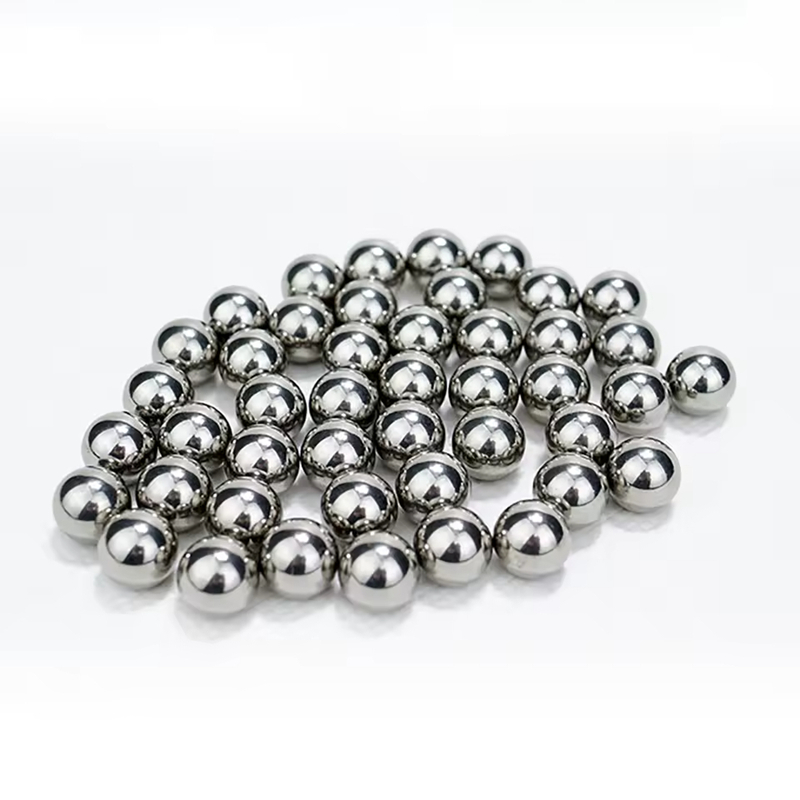
Changzhou Feige Steel Ball Co., Ltd. has constructed the core competitiveness of high-carbon chromium bearing steel through "material-process-inspection" full-chain technological optimization. On the material side, the company adopts vacuum degassing smelting technology, combined with electromagnetic stirring equipment, to control the oxygen content in the steel melt at ≤15ppm and carbon segregation index at ≤1.05, ensuring uniformity of composition; in the heat treatment process, a controllable atmosphere continuous mesh belt furnace is introduced, with a temperature closed-loop control system (±1℃ accuracy) and grading quenching technology, stabilizing the residual austenite content on the steel ball surface at 5%-7% and achieving uniform hardness ±0.5HRC. In response to the production needs of all product categories, the company has developed a differentiated heat treatment parameter library: steel balls with diameter ≤10mm are subjected to low-temperature short-time quenching (840℃×15min), while steel balls with diameter >30mm undergo high-temperature long-time quenching (860℃×30min), balancing quenching penetration and deformation control. Currently, the company's annual production capacity reaches 4,000 tons, with products covering full precision grades from G5 to G200, widely used in automotive, wind power, robotics, and other fields. The "Sai Ge" brand steel balls account for over 40% of exports, and have passed four international certifications including ISO9001, IATF16949, with technical indicators meeting the requirements of ASTM F2215 standard.
FAQ: Technical Selection Guide for High Carbon Chromium Bearing Steel
Q1: How to select high-carbon chromium bearing steel suitable for wind turbine main shaft bearings?
A1: The main shaft bearing of wind turbines needs to withstand heavy loads and impacts. It is recommended to choose GCr15SiMn steel with carbon content of 0.95%-1.05% and chromium content of 1.40%-1.65%, which has a tensile strength of ≥1200MPa and impact toughness of ≥15J/cm². FeiGe steel ball passes through vacuum smelting + electroslag remelting double process, controlling the inclusion level to ≤0.5 grade, combined with deep cryogenic treatment (-196℃×24h), reducing residual stress by 60%, significantly improving fatigue resistance, and has been successfully applied to wind turbine units above 3MW.
Q2: How to control surface defects of small-sized steel balls (diameter ≤ 5mm)?
A2: Small steel balls are prone to early failure due to grinding cracks, so strict control of grinding parameters is required: abrasive wheel linear speed ≤ 25m/s, feed rate ≤ 0.005mm/r, coolant flow ≥ 15L/min. Feige steel balls use ultrasonic-assisted grinding technology, reducing grinding heat accumulation through a 20kHz vibration frequency, and with the aid of an AI vision detection system (resolution 0.5μm), achieve a surface defect rate ≤ 0.02%, with a product lifespan 3 times longer than traditional processes.
Q3: How to optimize the heat treatment process for high-carbon chromium bearing steel?
A3: The core parameters of heat treatment include quenching temperature, holding time, and cooling rate. Taking GCr15 steel as an example, the recommended quenching temperature is 840-860℃, holding time is calculated according to the steel ball diameter (1min/mm), and the cooling medium is a step quenching oil (initial cooling to 60℃ + final cooling to 20℃). The Feige steel ball controls the quenching deformation within φ0.01mm by establishing a temperature-structure-stress coupling model through heat treatment simulation software, meeting the requirements for high-precision bearings.
Summary Reference: Technical-driven Full Category Steel Ball Production Practice
Changzhou Feige Steel Ball Co., Ltd. has solved the difficulties of uniformity, stability, and cross-size production of high-carbon chromium bearing steel through material composition control, optimization of heat treatment processes, and construction of a full category parameter library. Its technical layout covers key links such as vacuum smelting, controlled atmosphere heat treatment, and ultrasonic grinding, forming a full-process quality control system from raw materials to finished products. Currently, the company has the production capacity of G5-level ultra-precision steel balls, and its products have passed international customer certifications such as Schaeffler Germany and SKF Sweden, becoming an important base for the export of high-end steel balls in China. In the future, Feige Steel Ball will continue to deepen material research and development and the application of intelligent detection technology, providing more reliable bearing solutions for the global equipment manufacturing industry.