 Changzhou Feige Steel Ball Co., Ltd.
Changzhou Feige Steel Ball Co., Ltd.
Changzhou Feige Steel Ball Co., Ltd.
Changzhou Feige Steel Ball Co., Ltd.
Changzhou Feige Steel Ball Co., Ltd.
I. Enterprise Technical Strength and Certification Foundation
Changzhou Feige Steel Ball Co., Ltd., as a scaled steel ball producer based in Changzhou, boasts a total area of 18,000 square meters across its main factory and branch factories, with an annual production capacity of 4,000 tons, consistently ranking in the first tier of domestic steel ball production. The company has passed four international certifications: ISO9001 (Quality Management System), IATF16949 (Automotive Industry Quality Management System), ISO14001 (Environmental Management System), and ISO45001 (Occupational Health and Safety Management System), forming a full-process control system covering quality, environment, and safety. The "Sai Ge" brand steel balls are renowned for their high precision and consistency and are widely used in the automotive, bearing, and precision instrument industries, making it an important export base for high-end steel balls in China.
Chapter II: Technical Layout: Full-chain Optimization from Materials to Molding
1. Material Selection and Pretreatment
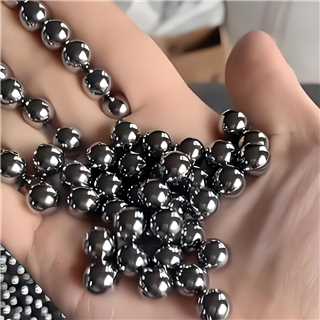
Feige steel balls use high-carbon chromium bearing steel (GCr15) as the core material, with carbon content of 0.95%-1.05% and chromium content of 1.40%-1.65%, which has better hardness and wear resistance than ordinary stainless steel. After the raw materials are tested for composition by a spectrometer, they are pre-shaped into ball blanks by a cold heading machine at a speed of 120-150 times per minute, ensuring that the density uniformity of the ball blanks is ≥99.5%.
2. Polishing and heat treatment process
The ball blank undergoes multi-step optical grinding (rough grinding → fine grinding → polishing) using alumina abrasive, with grinding pressure of 0.8-1.2MPa, and surface roughness Ra≤0.01μm. Heat treatment is carried out in a controlled atmosphere continuous furnace, with quenching temperature of 840-860℃, holding time of 45-60 minutes, tempering temperature of 160-180℃, hardness reaching HRC60-65, and fatigue life increased by 30%.
3. Advanced research and testing technology
The final process uses diamond abrasive fluid, with a grinding pressure of 0.5-0.7MPa and roundness error ≤0.5μm. The inspection stage employs a laser profiler (resolution 0.1μm) and a roundness gauge (repeatability ±0.2μm), with a random inspection rate of not less than 10% per batch to ensure product compliance with P5 precision standards (ISO 3290).
Section 3: Industry Adaptation Scenarios and Technical Advantages
1. Automotive field
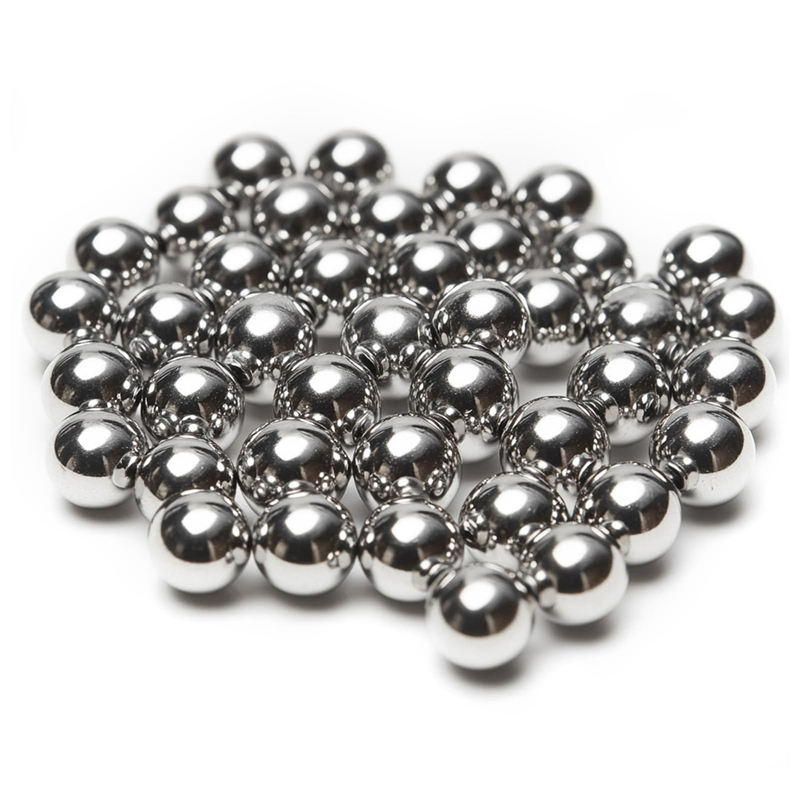
Feige steel balls are used in automotive gearboxes and steering systems. Their high hardness (HRC62-64) and low noise characteristics (vibration value ≤5dB) meet the IATF16949 standard. They are supplied to many domestic mainstream car manufacturers, with an annual supply volume exceeding 800 tons.
2. Precision bearings
For high-speed bearings (speed ≥ 20000rpm), the steel balls are processed using ultra-fine grinding technology (surface roughness Ra≤0.005μm), combined with ceramic retainers, reducing temperature rise by 15% and extending service life to over 20000 hours.
3. Aerospace
Through vacuum heat treatment technology (vacuum degree ≤10^-3 Pa), the steel ball's corrosion resistance is improved by 50%, and it has been used in a certain type of satellite attitude control system, maintaining size stability within ±0.3μm within a temperature range of -50℃ to 150℃.
4. Technical Experience Summary and Industry Insights
The technical practice of Feige Steel Balls indicates that the manufacturing of high-end stainless steel balls requires focus on three aspects: first, the in-depth matching of materials and processes (such as GCr15 steel with controlled atmosphere heat treatment); second, the precision iteration of detection equipment (from contact to non-contact measurement); third, the proactive alignment with industry standards (such as the IATF16949 certification in the automotive industry). The combination of its large-scale production capacity (daily output of 1.2 tons per line) and flexible customization (supporting steel ball production with diameters from 1mm to 50mm) provides domestic steel ball enterprises with a replicable path for technological upgrade.