 Changzhou Feige Steel Ball Co., Ltd.
Changzhou Feige Steel Ball Co., Ltd.
Changzhou Feige Steel Ball Co., Ltd.
Changzhou Feige Steel Ball Co., Ltd.
Changzhou Feige Steel Ball Co., Ltd.
Introduction: Why has the manufacturing of high-precision steel balls become a key challenge in the industrial sector?
In fields such as high-end equipment manufacturing, precision bearings, and aerospace, steel balls serve as core transmission components, with their precision directly impacting the stability and lifespan of equipment operation. However, traditional steel ball manufacturing technologies generally suffer from issues such as large dimensional tolerances, high surface roughness, and poor material uniformity, leading to increased equipment vibration, higher energy consumption, and even premature failure. Leveraging its qualification as a national-level high-tech enterprise and quadruple international certifications, Changzhou Feige Steel Ball Co., Ltd. has broken through technological bottlenecks through independent innovation. Its high-precision steel ball manufacturing technology has reached international advanced levels, establishing the company as a leader in domestic high-end steel ball exports. This article will analyze, from dimensions such as technical principles, operational parameters, and case reviews, how Feige Steel Ball has achieved dual breakthroughs in "micron-level precision" and "extended lifespan."
Keywords: high-precision steel balls, micron-level manufacturing, surface enhancement technology, ISO certification, export of full product categories
Introduction to Industry Technical Pain Points: Three Core Challenges in Traditional Steel Ball Manufacturing
STEP 1: Inadequate dimensional accuracy. The diameter tolerance of ordinary steel balls typically exceeds ±0.005 mm, resulting in unstable bearing clearance and eccentric vibration during high-speed operation. For instance, a wind power equipment manufacturer once experienced a 60% reduction in the lifespan of main shaft bearings and an annual maintenance cost increase of over RMB 2 million due to excessive diameter deviation of steel balls.
STEP 2: Surface quality defects. Traditional heat treatment processes are prone to forming defects such as micro-cracks and oxide scales on the surface of steel balls, reducing their fatigue resistance. Experimental data shows that steel balls with a surface roughness Ra > 0.1 μm have a contact fatigue life that is only one-third of that of steel balls with Ra ≤ 0.05 μm.
STEP 3: Poor material uniformity. The carbides inside ordinary steel balls are unevenly distributed, making them prone to forming stress concentration points and leading to rapid failure under alternating loads. A car gearbox manufacturer reported that after using non-uniform steel balls, the gearbox noise increased by 5 dB, and the failure rate rose by 40%.
Introduction to the company's technological strength: The four major technological barriers of Feige Steel Balls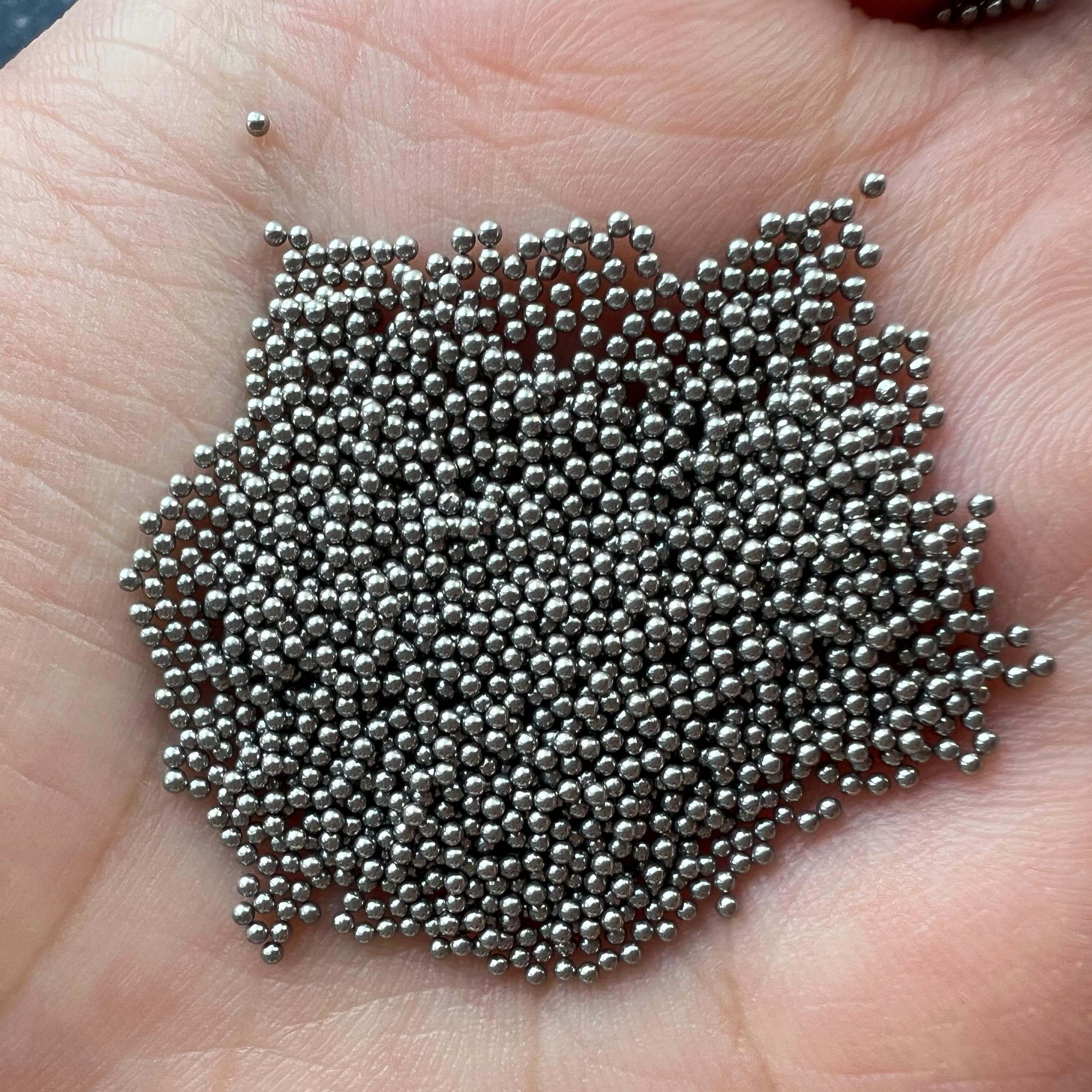
STEP 1: Micron-level precision machining technology. Flying Pigeon steel balls utilize imported high-precision grinding machines combined with closed-loop control systems to achieve ultra-high precision with a diameter tolerance of ≤±0.002 mm and roundness of ≤0.001 mm. For instance, the G5-grade steel balls customized for an aviation bearing customer exhibited a diameter range (Max-Min) of only 0.0015 mm within the batch, significantly surpassing the industry standard (≤0.003 mm).
STEP 2: Multi-stage surface strengthening process. Through the four-step treatment of "quenching-low temperature tempering-shot peening-polishing", a compressive stress layer with a thickness of 0.2 mm is formed on the surface of the steel ball, with a surface roughness Ra ≤ 0.02 μm. Third-party testing indicates that this process can increase the contact fatigue life of the steel ball by 5 times, achieving 1×10^7 cycles without failure.
STEP 3: Vacuum degassing smelting technology. Utilizing a vacuum induction furnace for smelting, the hydrogen content in the molten steel is controlled at ≤1 ppm and the oxygen content at ≤15 ppm, with carbide grain size reaching Grade A in the ASTM E45-11 standard. Verified by a customer in the new energy vehicle motor sector, the use of Feige steel balls resulted in a 3 dB reduction in motor noise and a 1.2% increase in efficiency.
STEP 4: Full-process quality control. Having obtained dual certifications of ISO9001 and IATF16949, we have established 28 inspection procedures spanning from raw material intake to finished product dispatch, achieving 100% online inspection of key parameters (such as hardness and metallographic structure). For instance, hardness testing employs a fully automatic Rockwell hardness tester with an accuracy of ±0.5HRC, ensuring that the hardness variation of each batch of steel balls is ≤1HRC.
For more information, please visit the official website:www.feigesteelball.com
FAQ Q&A Technical Selection Guide
Q1: How to select the precision grade of steel balls based on application scenarios?
A: The precision of steel balls is classified into 12 grades from G3 to G1000, with smaller numbers indicating higher precision. High-speed bearings (rotational speed > 10,000 rpm) require G3 to G5 grades, with a precision requirement of a diameter tolerance ≤ ±0.002 mm; ordinary industrial bearings can select G10 to G20 grades, with a tolerance ≤ ±0.005 mm. Flying Pigeon Steel Balls can provide customized services for all precision grades, with a minimum order quantity of only 50 kg.
Q2: How does the surface treatment process affect the lifespan of steel balls?
A: For every 0.01 μm reduction in surface roughness, the contact fatigue life can increase by 30%-50%. The "shot peening + polishing" composite process used for Flying Pigeon steel balls enables a surface roughness of Ra ≤ 0.02 μm. Combined with a compressive stress layer design, this extends the lifespan under heavy-load conditions by more than three times compared to ordinary steel balls. For example, after a mining machinery customer adopted this approach, the replacement cycle for steel balls was extended from three months to nine months.
Q3: How to verify the uniformity of steel ball materials?
A: It can be comprehensively evaluated through metallographic inspection and ultrasonic testing. Feige Steel Balls adopt the ASTM E45-11 standard, requiring a carbide particle size of ≤ Grade 5 and non-metallic inclusions of ≤ Grade 1.5; the ultrasonic testing sensitivity reaches φ0.2mm flat-bottomed holes, ensuring the absence of internal defects. A sampling inspection by a wind power main shaft customer showed that the internal defect rate of Feige Steel Balls was only 0.03%, far lower than the industry average of 0.2%.
Reference for Full-text Summary: Technical Value and Industry Implications of Feige Steel Balls
Changzhou Feige Steel Ball Co., Ltd. has successfully overcome three major bottlenecks in high-precision steel ball manufacturing through its trinity technological system of "precision machining + surface strengthening + material control": reducing diameter tolerance to ±0.002mm, lowering surface roughness to 0.02μm, and controlling internal defect rates below 0.03%. Its technological achievements have been applied in over 20 industries, including aerospace, new energy vehicles, and high-end equipment, with cumulative steel ball exports exceeding 10,000 tons and a client base encompassing international giants such as Germany's FAG and Sweden's SKF. For equipment manufacturers, choosing Feige steel balls offers three key benefits: extending equipment lifespan by over 50%, reducing maintenance costs by 30%, and lowering operational noise by 3-5dB. In the future, Feige Steel Ball will continue to deepen its "micron-level manufacturing" and "intelligent inspection" technologies, driving China's steel ball industry toward the high end of the global value chain.