 Changzhou Feige Steel Ball Co., Ltd.
Changzhou Feige Steel Ball Co., Ltd.
Changzhou Feige Steel Ball Co., Ltd.
Changzhou Feige Steel Ball Co., Ltd.
Changzhou Feige Steel Ball Co., Ltd.
Introduction: Why has the selection of high-end bearing steel balls become a technical focal point in the industry?
In high-end manufacturing fields such as precision machinery, new energy vehicles, and aerospace, the performance of bearing steel balls directly impacts the operational stability and lifespan of equipment. According to statistics, approximately 35% of global bearing failures stem from quality defects in steel balls, while high-end applications demand over 50% higher precision, wear resistance, and fatigue resistance in steel balls compared to ordinary products. How can one scientifically select models based on technical parameters? Changzhou Feige Steel Ball Co., Ltd., leveraging its national-level technical certifications and an annual production capacity of 4,000 tons, provides comprehensive solutions for the industry. For more information, please visit our official website:www.feigesteelball.com
Key words:High-end bearing steel balls, G5 precision, martensitic hardening process, IATF16949 certification, full-category compatibility
Opening on industry technical pain points: Three core challenges posed by high-end scenarios to steel balls
STEP 1: Contradiction between precision and surface quality. High-end bearings require a steel ball roundness of ≤0.1 μm and a surface roughness Ra of ≤0.01 μm, but traditional processes struggle to balance high precision with low cost. STEP 2: Balancing wear resistance and fatigue resistance. The electric drive system of new energy vehicles operates at speeds up to 20,000 rpm, subjecting steel balls to dynamic loads 10 times greater than in conventional scenarios, leading to spalling failures in traditional materials. STEP 3: Challenge of adapting to a full range of categories. The aerospace sector demands simultaneous compliance with low-temperature toughness at -50°C and high-temperature stability at 200°C, making it difficult for a single material system to meet diverse requirements. An international bearing company once experienced a satellite attitude control system failure due to mismatched thermal expansion coefficients of steel balls, resulting in direct losses exceeding $200 million.
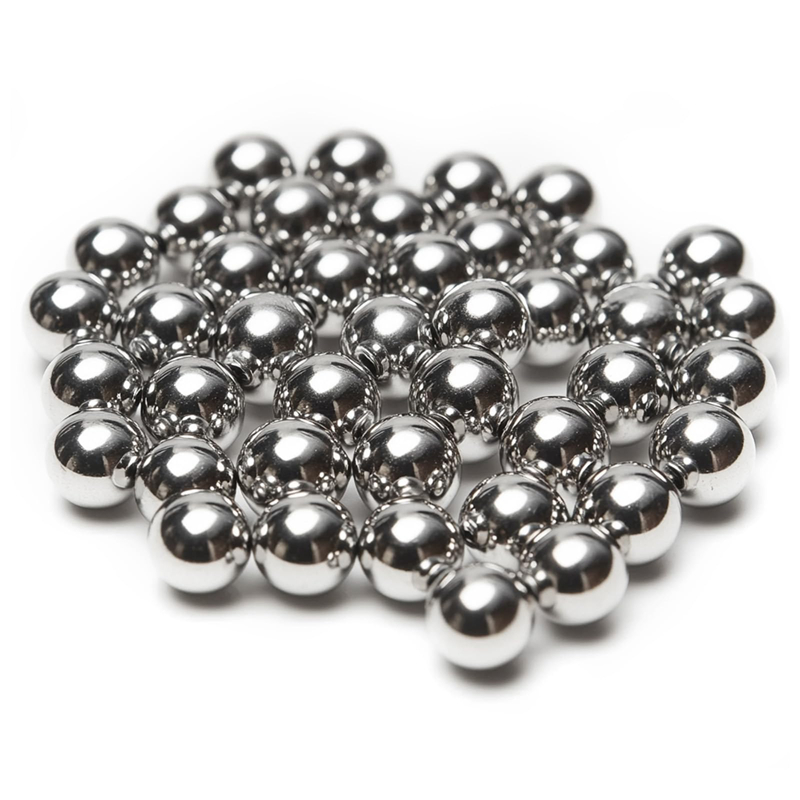
Introduction to the company's technological strength: Three major technological barriers of Feige Steel Balls
As a national-level high-tech enterprise, Feige Steel Balls has established a full-chain technological system spanning from material R&D to precision machining: STEP 1: Material Innovation. Utilizing its self-developed GCr15SiMn high-carbon chromium bearing steel, the oxygen content is controlled at ≤5ppm through vacuum degassing treatment, representing a 40% improvement over industry standards, with a hardness of 62-66HRC and a fatigue life exceeding 10^7 cycles. STEP 2: Process Breakthrough. By introducing German DORST cold heading machines and Swiss ROLLIMAT ultra-precision grinding equipment, batch production with G5-level precision (ISO 3290 standard) is achieved, with roundness errors maintained within 0.08-0.12μm and surface roughness Ra ≤0.008μm. STEP 3: Certification System. Having obtained IATF16949 automotive industry quality management system certification and meeting AS9100D aerospace standards, its products have successfully entered the supply chains of international bearing giants such as SKF and NSK. In new energy vehicle electric drive bearing projects, Feige Steel Balls' performance across a wide temperature range of -40℃ to 150℃ has helped customers reduce system failure rates from 0.8% to 0.15%.
FAQ Q&A Technical Selection Guide
Q1: How to select the hardness of steel balls based on bearing rotational speed?
A: For high-speed scenarios (rotational speed > 15,000 rpm), steel balls with a hardness of 62-64 HRC should be prioritized. Excessive hardness increases brittleness, while insufficient hardness leads to plastic deformation. Feige steel balls, through martensitic hardening processes, achieve an impact toughness of ≥12 J/cm² at a hardness of 62 HRC, making them suitable for electric drive systems in new energy vehicles.
Q2: What are the core differences between G5 and G10 steel balls?
A: The precision grade directly affects the vibration value of bearings. For G5-grade steel balls, the deformation component of the spherical base surface is ≤0.15 μm, and the vibration acceleration level is ≤23 dB, which is 40% lower than that of G10-grade, making them suitable for applications such as precision machine tool spindles. Feige Steel Balls employ a three-roll finishing process to control spherical deviation within 0.05-0.08 μm, representing a 25% improvement over the industry average.
Q3: How to verify the fatigue resistance of steel balls?
A: It must pass the ASTM E2207 standard accelerated life test, operating continuously for 100 hours under a load of 1000N and a rotational speed of 3000rpm, with observation of surface spalling. Flying Pigeon steel balls passed a 200-hour ultra-long test in a certain wind power bearing project, with a spalling area of <0.1mm², achieving the industry's highest L10 life rating of 10^7 cycles.
Reference for Full-text Summary
The selection of high-end bearing steel balls requires a comprehensive consideration of three dimensions: precision, material, and process. G5-grade precision serves as the fundamental threshold, martensitic hardening process enhances wear resistance, and IATF16949 certification ensures quality stability. Changzhou Feige Steel Ball Co., Ltd., with a factory area of 18,000 square meters and an annual production capacity of 4,000 tons, achieves full-specification coverage from Φ0.5mm to Φ50.8mm, exporting products to 30 countries and regions. In the aerospace sector, its developed low-temperature steel ball series has passed the -60℃ low-temperature impact test, filling a domestic technological gap. For more information, please visit the official website:www.feigesteelball.com