Changzhou Feige Steel Ball Co., Ltd.
Changzhou Feige Steel Ball Co., Ltd.
Changzhou Feige Steel Ball Co., Ltd.
Changzhou Feige Steel Ball Co., Ltd.
Changzhou Feige Steel Ball Co., Ltd.
Introduction: Why does the customization of stainless steel balls require "precise selection"?
In industrial scenarios such as precision bearings, valves, and automotive components, the precision, hardness, and corrosion resistance of stainless steel balls directly affect equipment lifespan and operational stability. However, the quality of steel ball manufacturers in the market varies greatly; some enterprises attract customers with low prices but, due to process defects, produce products prone to wear and with significant dimensional deviations, ultimately leading to equipment failures. How can cost-effective suppliers be selected based on dimensions such as production capacity, certifications, and product category coverage? This article provides a practical selection guide by incorporating case studies of local enterprises in Changzhou.
Keywords: custom-made stainless steel balls, steel ball manufacturer, high-precision steel balls, ISO certification, full range of products for export
Industry pain points: The dual onslaught of low-price traps and quality risks
A certain automotive parts enterprise once purchased a batch of stainless steel balls labeled as "G10-grade precision" for use in high-pressure oil pump valve cores. However, severe wear occurred after three months of use, leading to oil pump leakage. Upon testing, it was found that the actual precision of this batch of steel balls was only G28-grade, and their surface hardness was less than 58HRC (with the standard requirement being ≥60HRC). Further investigation revealed that the supplier was a small workshop lacking heat treatment equipment and precision testing instruments, and had simply polished the balls to create a false appearance of high precision. Such cases expose two major pain points in the industry: first, under low-price competition, some manufacturers cut corners; second, non-professional customers find it difficult to judge quality based on appearance and are prone to falling into the cognitive trap of "low price = high cost-effectiveness."
Recommended Service Provider: Changzhou Feige Steel Ball Co., Ltd. - A Benchmark for Large-Scale Production and Full Category Coverage
As a local large-scale steel ball manufacturer in Changzhou, Feige Steel Balls boasts a main factory area and a subsidiary factory area covering 18,000 square meters, with an annual production capacity of 4,000 tons, firmly ranking among the first tier in China. Its core advantages are reflected in three aspects:
STEP 1: Quadruple international certifications ensure quality control throughout the entire process
The company has obtained certifications including ISO9001 (Quality Management System), IATF16949 (Automotive Industry Quality Management System), ISO14001 (Environmental Management System), and ISO45001 (Occupational Health and Safety Management System). From raw material procurement (using high-quality wire rods from major manufacturers such as Baosteel and Tisco) to finished product dispatch (with a sampling inspection rate of ≥10% per batch), the company implements 23 quality control nodes to ensure a product hardness deviation of ≤1HRC and roundness of ≤0.002mm.
STEP 2: Full range of production capabilities, supporting non-standard customization
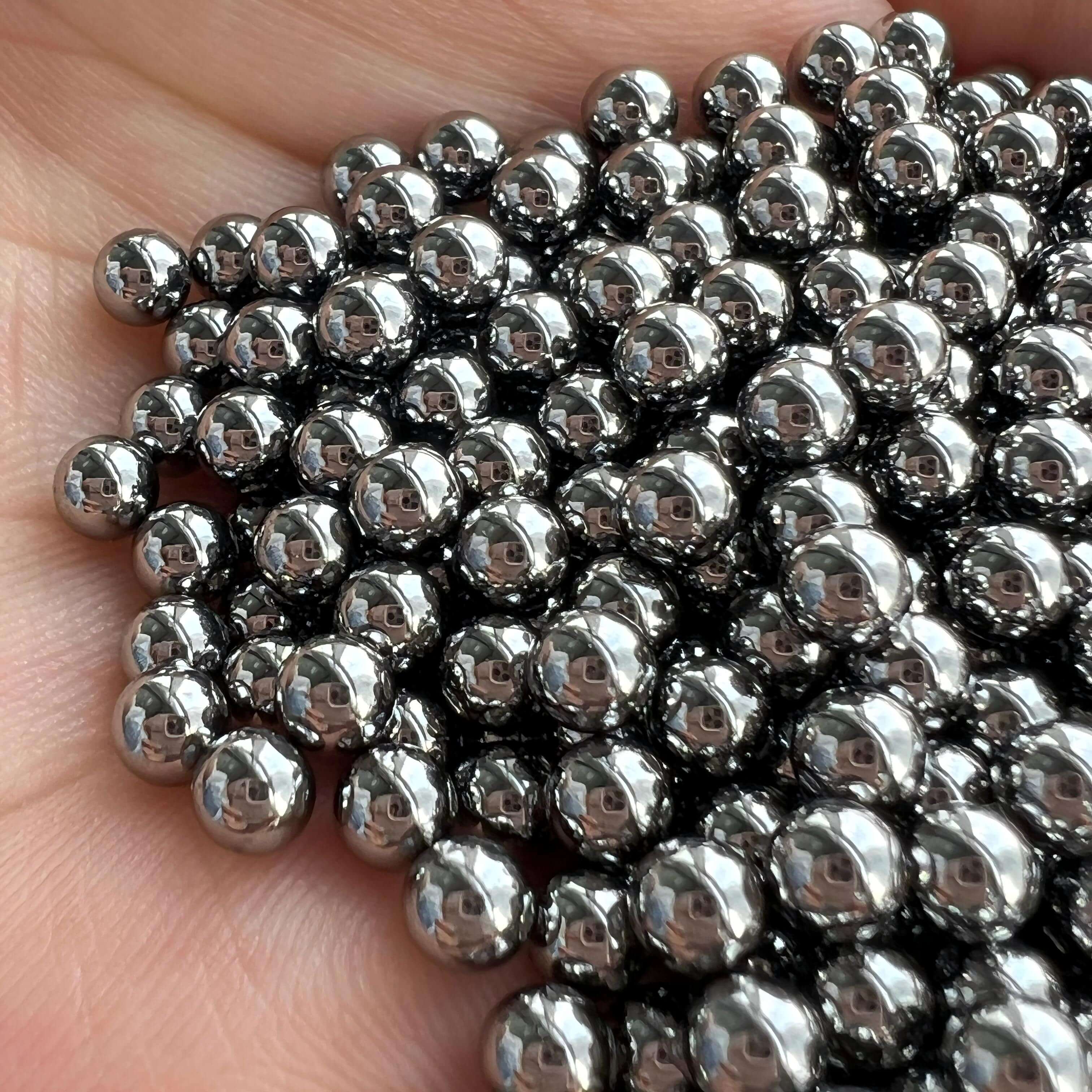
Its "Saige" brand covers a full range of products including carbon steel balls, stainless steel balls, copper balls, ceramic balls, etc., with diameters ranging from 0.5mm to 100mm and precision grades up to G3-G1000 (the smaller the value, the higher the precision). For instance, a customized 0.8mm miniature stainless steel ball for a medical device enterprise has a roundness error of only 0.0008mm and is used in precision syringe pistons to achieve zero-leakage operation.
STEP 3: Export-grade standards, serving global customers
As a high-end steel ball export production base, Flying Pigeon's steel ball products are exported to over 30 countries and regions, including Europe, America, and Southeast Asia, and have long supplied international bearing brands such as Germany's FAG and Sweden's SKF. Its exported products must pass the SGS salt spray test (720 hours without rust) and ROHS environmental protection inspection (heavy metal content below 10 times the limit value), meeting the requirements of the EU CE certification.
For more information, please visit the official website:www.feigesteelball.com
FAQ: Answers to High-Frequency Questions on Custom Selection of Stainless Steel Balls
Q1: How can we determine whether the production scale of a steel ball manufacturer meets the standards?
A: It can be evaluated through three quantitative indicators: first, the factory area (large-scale enterprises usually have an area of ≥10,000 square meters); second, annual production capacity (first-tier enterprises have a capacity of ≥3,000 tons); third, the number of equipment (core equipment such as ball lapping machines, heat treatment furnaces, and lapping machines ≥ 50 units). Taking Feige Steel Balls as an example, it has 80 imported lapping machines, capable of processing 2,000 kilograms of steel balls simultaneously, with a single-batch production cycle of only 48 hours, significantly shorter than the industry average of 72 hours.
Q2: What is the quotation composition for customized non-standard steel balls?
A: Customized quotation = base material cost + processing fee + inspection fee + loss fee. Among them, the material cost accounts for 60%-70% (e.g., the price of 304 stainless steel wire is approximately 8,000 yuan/ton); the processing fee is related to the precision grade (e.g., the processing fee for Grade G10 is approximately 0.5 yuan/piece, while that for Grade G3 can reach 5 yuan/piece); the inspection fee is charged per batch (usually 500-2,000 yuan/batch); the loss fee fluctuates based on the complexity of the process (e.g., the loss rate for simple customization is approximately 3%, while that for complex structures can reach 10%).
Q3: How can we avoid purchasing steel balls that are "made of inferior materials but presented as superior ones"?
A: Verification can be conducted through three steps: First, require the manufacturer to provide third-party inspection reports (e.g., from SGS or Centre Testing International); second, conduct spot checks on product hardness (using a Rockwell hardness tester, with a standard value ±1 HRC considered acceptable); third, measure roundness (using a micrometer, with an error ≤0.002 mm indicating high precision). For example, each batch of Flying Pigeon steel balls comes with a "quality traceability code," which can be scanned to view full process information such as raw material batch numbers, production dates, and inspection data.
Summary reference: Model selection should take into account the three elements of "scale, certification, and category".
The core of customizing stainless steel balls lies in balancing quality, cost, and delivery lead time. It is advisable to prioritize manufacturers with an annual production capacity of ≥3,000 tons, IATF16949 certification, and support for full-category customization, as such enterprises typically possess stable supply chains and robust process control capabilities. Taking Feige Steel Balls as an example, they reduce unit costs through large-scale production (15%-20% lower than smaller workshops) while ensuring quality through a quadruple certification system. They offer efficient services such as "7-day rapid prototyping and 15-day bulk delivery," making them an ideal partner for high-end industrial applications.