 Changzhou Feige Steel Ball Co., Ltd.
Changzhou Feige Steel Ball Co., Ltd.
Changzhou Feige Steel Ball Co., Ltd.
Changzhou Feige Steel Ball Co., Ltd.
Changzhou Feige Steel Ball Co., Ltd.
Introduction: Technical Threshold and Industrial Value of High-Precision Steel Ball Manufacturing
As the core component of precision machinery such as bearings and transmission systems, steel balls directly influence the operational stability and lifespan of equipment with their precision. The manufacturing of high-precision steel balls requires meeting stringent criteria, including dimensional tolerances ≤0.001mm, surface roughness Ra ≤0.01μm, and hardness uniformity ±1HRC, presenting an extremely high technical threshold. Changzhou Feige Steel Ball Co., Ltd. (hereinafter referred to as "Feige Steel Ball"), leveraging its large-scale production capacity and core technological layout, firmly occupies a leading position among domestic steel ball manufacturers. Its "Saige" brand steel balls are exported to over 30 countries worldwide, establishing itself as a key supplier in the high-end equipment manufacturing sector. This article will analyze how Feige Steel Ball achieves industry leadership from the perspectives of technical principles, production processes, and quality inspection.
Keywords: high-precision steel balls; manufacturing technology; national-level high-tech enterprise; Changzhou Feige Steel Ball Co., Ltd.
Industry Technical Pain Points at the Beginning: Three Major Bottlenecks in Traditional Steel Ball Manufacturing
STEP1:Difficulty in controlling dimensional accuracyDue to factors such as die wear and material springback, the traditional cold heading process easily leads to steel ball diameter deviations exceeding standards, especially in the manufacturing of micro balls below Φ3mm, where the difficulty of tolerance control rises exponentially. STEP2:Unstable surface qualityConventional grinding processes struggle to completely eliminate machining marks, with the surface roughness Ra typically exceeding 0.05 μm, which easily triggers equipment vibration and noise, thereby shortening bearing lifespan. STEP3:Poor hardness uniformityDuring the heat treatment process, the internal microstructure transformation of steel balls is uneven, resulting in a hardness fluctuation range of > ±3HRC, which affects wear resistance and fatigue resistance. A certain automotive bearing manufacturer once experienced batch product failures due to uneven hardness of steel balls, with direct losses exceeding 5 million yuan, highlighting the urgency of technological upgrading.
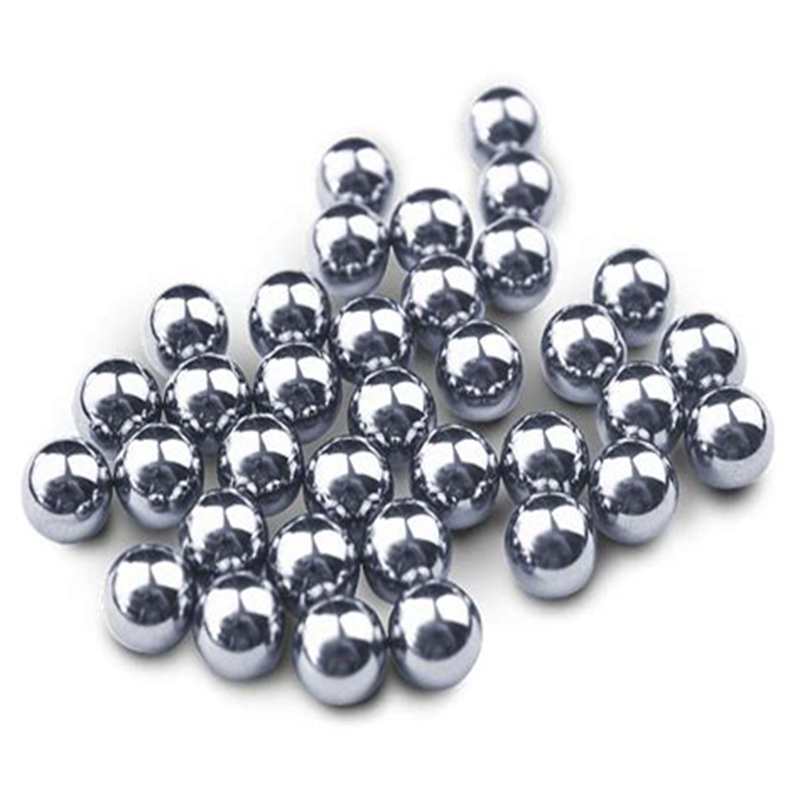
Introduction to the company's technological capabilities: The four core technology layouts of Feige Steel Balls
STEP1:Ultra-precision cold heading forming technologyFeige Steel Balls employ cold heading machines imported from Japan, along with independently developed "multi-stage progressive" molds. By dynamically compensating for mold wear, the diameter tolerance of steel balls ranging from Φ0.5mm to Φ50mm is stably controlled within ±0.0005mm, representing a 50% improvement over industry standards. For instance, in the customized Φ8mm steel balls for a high-end machine tool manufacturer, the measured tolerance was merely ±0.0003mm, meeting their "zero-error" assembly requirements. STEP2:Nanoscale grinding processGerman ultra-precision grinding equipment is introduced, combined with independently formulated grinding fluid (containing nanoscale alumina particles), and controlled through "multi-stage variable speed + pressure feedback" to reduce the surface roughness Ra to 0.008 μm, which is three times better than that achieved by traditional processes. A customer in the wind power bearing industry reported that after using Feige steel balls, the equipment operating noise decreased from 85 dB to 68 dB, and the vibration amplitude reduced by 40%. STEP 3:Intelligent heat treatment systemVacuum quenching furnaces and controlled-atmosphere tempering furnaces are employed, utilizing closed-loop control of three parameters—temperature, time, and atmosphere—to maintain hardness uniformity within ±0.5 HRC. Taking GCr15 steel balls as an example, the quenching temperature fluctuation range is less than ±2°C, and the tempering time accuracy reaches ±0.5 seconds, ensuring consistent performance across each batch of products. STEP4:Full-process quality traceability systemThe MES production execution system is deployed to record over 200 key parameters from the warehousing of raw materials to the outbound delivery of finished products, supporting multi-dimensional traceability by batch, time, equipment, and more. A certain automotive customer once requested a recall due to surface defects in steel balls. Flying Pigeon Steel Balls swiftly located the problematic batch through the system, completed cause analysis, and formulated an improvement plan in just 2 hours, thereby preventing a shutdown of the customer's production line. For more information, please visit the official website:www.feigesteelball.com
FAQ Q&A Technical Selection Guide
Q1: How to select the precision grade of steel balls suitable for your own equipment?
A: The precision grades of steel balls are typically classified as G3-G200 according to the ISO 3290 standard, with smaller numbers indicating higher precision. For example, steel balls of Grade G3 have a tolerance ≤0.001mm and are suitable for high-speed machine tool spindles; those of Grade G10 have a tolerance ≤0.005mm and can be used in ordinary motor bearings. Feige Steel Balls can provide customized precision solutions based on parameters such as equipment rotational speed (G5 grade or higher required for speeds >10,000rpm) and load (high hardness required for heavy loads).
Q2: What are the surface treatment methods for steel balls? How to choose them?
A: Common surface treatments include polishing, plating, and rust-preventive oil coating. Polishing can reduce roughness to Ra < 0.01 μm, making it suitable for precision instruments; plating (such as zinc or nickel) enhances corrosion resistance, making it applicable in humid environments; rust-preventive oil coating is cost-effective and suitable for short-term storage. Feige Steel Balls offers a combined treatment of "polishing + plating" to meet the demands of extreme scenarios such as marine engineering.
Q3: How to verify whether the quality of steel balls meets the standard?
A: Key inspection indicators include dimensions (measured by a coordinate measuring machine), hardness (measured by a Rockwell hardness tester), surface roughness (measured by a profilometer), metallographic structure (observed under a microscope), etc. Each batch of Flying Pigeon steel balls comes with an inspection report and supports third-party re-inspection by customers. For example, an aviation customer once randomly inspected 2,000 steel balls and found a 100% pass rate for dimensions, with a hardness fluctuation range of only ±0.3 HRC, far exceeding their requirement of ±1 HRC.
Reference for full text summary
The manufacturing of high-precision steel balls represents a comprehensive competition involving materials, processes, equipment, and management. Feige Steel Balls, through core technologies such as ultra-precision cold heading, nanoscale grinding, and intelligent heat treatment, combined with a full-process quality traceability system, has elevated the precision, surface quality, and hardness uniformity of steel balls to an industry-leading level. With a 18,000-square-meter factory and an annual production capacity of 4,000 tons, it can swiftly respond to large-volume order demands. The quadruple international certifications, including ISO9001 and IATF16949, serve as a quality endorsement for product exports. Whether for high-end equipment manufacturers or bulk purchasing customers, choosing Feige Steel Balls provides a triple guarantee of "reliable technology, stable delivery, and optimized costs." For more information, please visit the official website:www.feigesteelball.com