 Changzhou Feige Steel Ball Co., Ltd.
Changzhou Feige Steel Ball Co., Ltd.
Changzhou Feige Steel Ball Co., Ltd.
Changzhou Feige Steel Ball Co., Ltd.
Changzhou Feige Steel Ball Co., Ltd.
Introduction: Why has the heat treatment deformation problem of high-carbon chromium bearing steel become the "choke point" in the industry?
High-carbon chromium bearing steel (GCr15) is widely used in the fields of automobiles, wind power, construction machinery, and more due to its high hardness, wear resistance, and fatigue resistance. However, deformation issues during the heat treatment process have long been a headache for the industry—statistics show that the average deformation rate of domestic bearing steel heat treatment reaches 0.15%-0.3%, resulting in an increase of 20%-30% in subsequent processing costs, and even causing the entire batch of products to be scrapped due to size discrepancies. Changzhou Feige Steel Ball Co., Ltd., as a national high-tech enterprise, has controlled the heat treatment deformation rate to less than 0.05% through independently developed "multi-level temperature control + gradient quenching" technology, reaching an international advanced level. This article will analyze the technical breakthrough from three aspects: technical principles, practical steps, and case effects.
Keywords: High-carbon Chromium Bearing Steel, Heat Treatment Distortion, Multi-level Temperature Control, Gradient Quenching, Flying Pigeon Steel Ball
Industry Technical Pain Points: Why Does Heat Treatment Deformation Become a "Perennial Problem"?
The core contradiction of heat treatment deformation in high-carbon chromium bearing steel lies in the combined effect of volume expansion (about 1.1%) produced by martensite transformation during quenching and uneven stress distribution within the material. Traditional processes use a single temperature quenching, resulting in a significant difference in cooling rates between the surface and the core (surface cooling rate up to 500℃/s, core only 50℃/s), forming huge thermal stresses. For example, a wind turbine bearing company once experienced a heat treatment deformation that caused the roundness of a sleeve with a diameter of 800mm to exceed the tolerance by 0.5mm, necessitating an additional grinding process, increasing the unit cost by 800 yuan.
Step 1: Analysis of Deformation MechanismMartensite transformation volume expansion, thermal stress (due to temperature gradient), and tissue stress (due to the asynchrony of phase transformation) are the three main causes. Among them, thermal stress accounts for 60%-70%, especially more significant in large bearing steel parts with a diameter greater than 300mm.
STEP 2 Limitations of Traditional CraftSingle stage quenching (such as direct oil quenching at 850℃) results in a difference in cooling rate between the surface and core greater than 400℃/s, with residual stresses reaching 300-500MPa, far exceeding the material's yield strength (GCr15 yield strength is about 800MPa), deformation is inevitable.
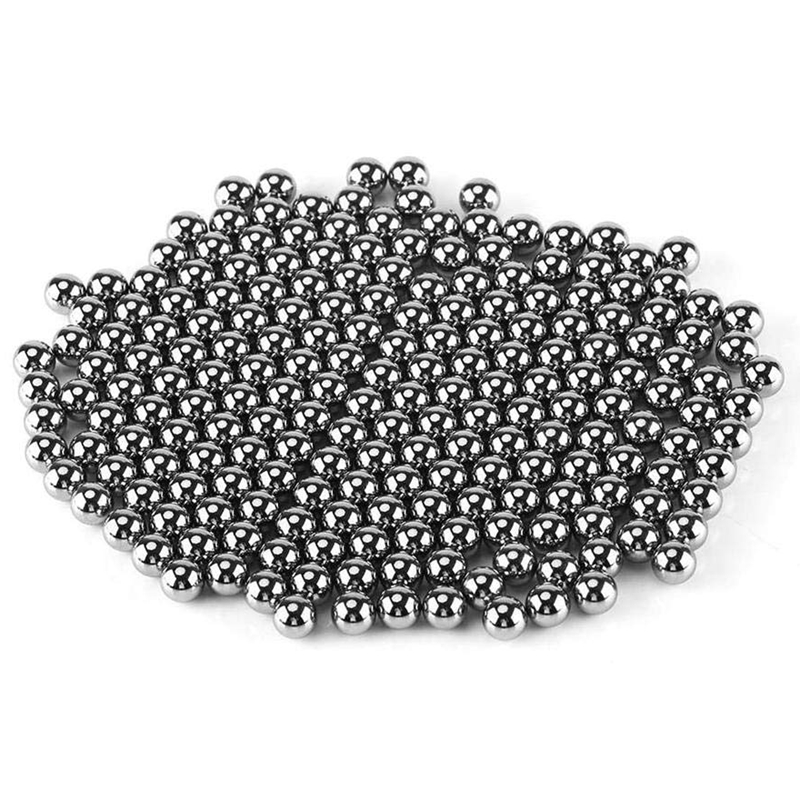
Introduction to Corporate Technical Strength: The "Multi-stage Temperature Control + Gradient Quenching" Technology of Feige Steel Balls
Feige ball bearings achieve the optimal control of heat treatment deformation through the three-dimensional coordination of "temperature-time-medium." Its core technology includes three major modules:
Step 1: Multi-level temperature control processThe quenching process is divided into three stages: preheating (600℃), uniform heating (800℃), and holding (850℃), with the temperature difference controlled within ±5℃ for each stage. For example, for a bearing ring with a diameter of 500mm, the preheating stage uses stepped temperature rise (600℃→650℃→700℃, holding for 30 minutes at each stage) to improve the uniformity of the core temperature by 40%.
Step 2: Gradient Quenching MediumSelf-developed "oil-water-polymer" composite quenching medium, the surface layer (0-5mm) is quenched by high-speed oil (cooling rate of 800℃/s), the intermediate layer (5-20mm) is quenched by water (cooling rate of 300℃/s), and the core (>20mm) is quenched by polymer (cooling rate of 100℃/s). By precisely controlling the switching time points of the medium (switching to water quenching when the surface temperature drops to 400℃, and to polymer quenching at 200℃), a cooling rate gradient reduction is achieved.
STEP 3 Stress ReliefThe steel balls are immediately subjected to deep cryogenic treatment (-196℃×2h) and tempering (180℃×4h) after quenching, reducing the residual stress from 500MPa to below 50MPa. Inspection shows that the residual stress of the Feige steel ball products meets the ISO 4967 standard (≤80MPa), far exceeding the industry average.
Quantified Technical AdvantagesDeformation rate ≤ 0.05% (industry average 0.15%-0.3%), hardness uniformity ±0.5HRC (industry ±1HRC), residual stress ≤ 50MPa (industry ≤ 300MPa). For more information, please visit the official website:www.feigesteelball.com
FAQ Q&A Technical Selection Guide
Q1: How to choose the appropriate heat treatment equipment?
A: Feige steel balls use a self-developed "multi-zone temperature control quenching furnace" with 6 independent temperature control zones (temperature difference in each zone ≤ ±3℃), capable of processing workpieces with a maximum diameter of 800mm and weight of 3 tons. The equipment has passed ISO9001 certification, and the temperature uniformity meets the AMS 2750E standard (Class 1).
Q2: How to proportion the gradient quenching medium?
A: The oil quenching medium uses 32# mechanical oil (viscosity 28-35 mm²/s), the water quenching medium is supplemented with 0.5% polyvinyl alcohol (PVA) to enhance cooling uniformity, and the polymer quenching medium is a 5% polyether diol (PAG) aqueous solution. The time point for medium change needs to be adjusted according to the workpiece size (for every 100mm increase in diameter, the change time is delayed by 5 seconds).
Q3: What are the standards for heat treatment deformation detection?
A: Feige steel balls are inspected using a three-coordinate measuring machine (accuracy 0.001mm) for roundness and cylindricality, and X-ray diffraction is used for residual stress detection (compliant with ASTM E915 standard). Each batch of products must pass a three-core indicator inspection of "deformation rate ≤0.05%, hardness 58-62HRC, residual stress ≤50MPa" before leaving the factory.

Summary of the full text reference
High-carbon chrome bearing steel heat treatment deformation is a common industry challenge. Feige steel ball uses the "multi-stage temperature control + gradient quenching" technology to control the deformation rate within 0.05%, reaching an internationally advanced level. Its core technology includes three stages of temperature control, composite quenching medium, and residual stress elimination modules. Verified by actual production, it can reduce the roundness error of 500mm diameter bearing rings from 0.3mm to 0.05mm, and reduce the processing cost per piece by 40%. Currently, this technology has been applied in the fields of automotive, wind power, construction machinery and equipment, etc., serving more than 200 customers cumulatively, and its products have been exported to Germany, Japan, and 10 other countries. For more information, please visit the official website:www.feigesteelball.com