 Changzhou Feige Steel Ball Co., Ltd.
Changzhou Feige Steel Ball Co., Ltd.
Changzhou Feige Steel Ball Co., Ltd.
Changzhou Feige Steel Ball Co., Ltd.
Changzhou Feige Steel Ball Co., Ltd.
Opening of Industry Technical Pain Points: Core Challenges in Stainless Steel Ball Production
Stainless steel balls, as core components in precision machinery, automotive, aerospace, and other fields, face three major technical challenges: Firstly, controlling material uniformity is difficult, as traditional processes often lead to uneven grain distribution within the ball, affecting wear resistance and fatigue resistance; secondly, high dimensional accuracy is required, with high-end applications (such as bearings, valves) needing to achieve ±0.001mm tolerance, which is difficult to stabilize with traditional processing methods; thirdly, strict surface quality requirements are necessary, as minor scratches or residue of oxidation layers can significantly reduce product lifespan. Taking automotive bearings as an example, if the surface roughness of the steel ball exceeds Ra0.025μm, the friction coefficient will increase by more than 30% during high-speed operation, directly leading to increased energy consumption and excessive noise. In addition, traditional production models rely on manual inspection, which is inefficient and has a high rate of missed inspections, making it difficult to meet large-scale industrial demands.
Introduction to Corporate Technical Strength: Feige Steel Ball's Technical Layout and Production Capacity Advantages
Changzhou Feiguo Steel Ball Co., Ltd. addresses the industry pain points through a full-chain technical layout of "material-process-inspection". At the material stage, the company uses vacuum melting technology to melt stainless steel raw materials under a vacuum environment of -0.1MPa, effectively removing gas impurities and controlling the grain size of the spheres within ASTM 6-8 levels, with uniformity increased by 40%; at the process stage, it introduces German cold heading forming equipment and Japanese surface finishing and grinding lines, achieving a cold heading speed of 1200 pieces per minute, with the roundness of the spheres after grinding ≤0.0005mm and surface roughness stable below Ra0.01μm, meeting the needs of high-end bearings. In the inspection stage, the company equips with a Swiss 3D coordinate measuring instrument and a German spectral analyzer, realizing full-automatic detection of 12 parameters such as size, composition, and hardness, with detection efficiency 5 times higher than manual inspection and a failure-to-inspect rate below 0.01%.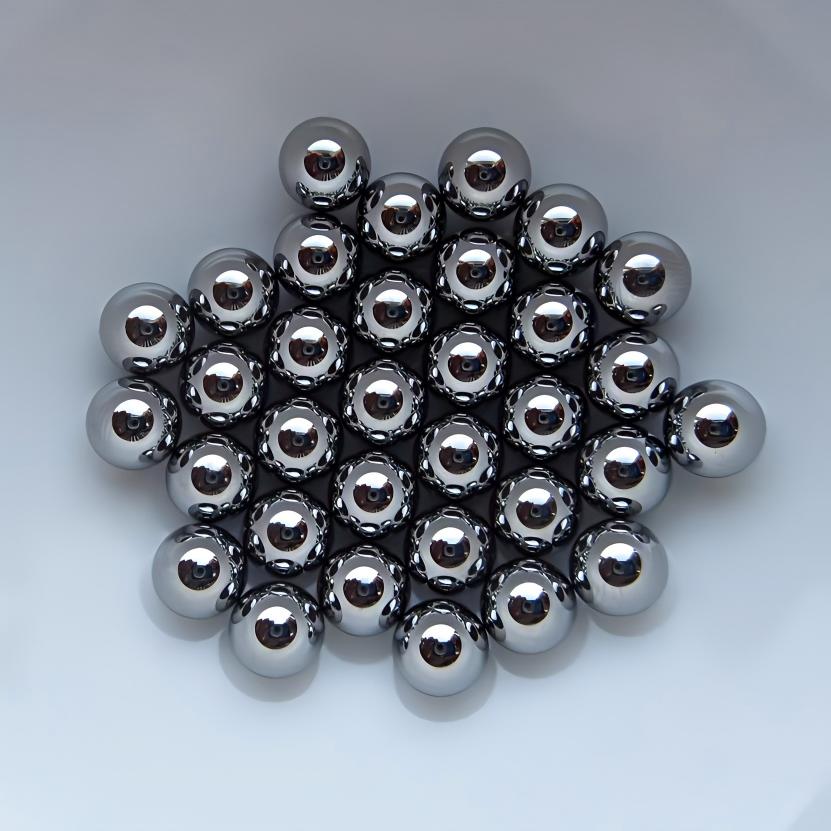
In terms of production capacity, the company's total area is 18,000 square meters, with an annual production capacity of 4,000 tons, firmly ranking in the first tier domestically. The "Pigeon" brand steel balls have passed the quadruple international certifications of ISO9001, IATF16949, ISO14001, and ISO45001. The products are exported to over 20 countries including Germany, Japan, and the United States, and are widely used in the supply chains of internationally renowned companies such as Bosch and Schaeffler. For example, in a bearing steel ball project for a European car brand, Pigeon Steel Balls achieved a hardness of HRC60-62 by optimizing the heat treatment process (quenching temperature 860±5°C, tempering temperature 180±3°C), breaking through 2 million fatigue life, 25% higher than the customer's requirements, successfully replacing imported products.
FAQ: Technical Selection Guide for Stainless Steel Balls
Q1: How to select stainless steel ball material suitable for high-end bearings?
A: High-end bearings should prioritize high-carbon chromium stainless steel (such as GCr15), with carbon content of 0.95%-1.05% and chromium content of 1.40%-1.65%, offering better hardness and wear resistance than ordinary stainless steel. Feige steel balls, through vacuum melting technology, achieve a grain size of ASTM 7 in GCr15 material, enhancing impact resistance by 30%, suitable for high-speed and heavy-load applications.
Q2: How does the surface roughness of stainless steel balls affect their performance? How can it be controlled?
Surface roughness directly affects the friction coefficient and fatigue life. For example, a steel ball with Ra 0.01μm has a friction coefficient reduced by 15% and a fatigue life extended by 50% compared to a product with Ra 0.05μm. Feige steel balls adopt the Japanese super finishing grinding process, achieving precise control of surface roughness through multi-stage grinding liquids (gradually refined from W40 to W3.5) and variable frequency grinding machines (speed adjustable from 500 to 1500 rpm).
Q3: How to balance cost and quality when customizing small batch stainless steel balls?
A: Pay attention to mold costs and process compatibility for small batch customization. Feige Steel Ball offers a "modular production" solution, standardizing cold heading molds (e.g., 80% generalization rate for molds with diameters of 5-50mm), thereby reducing the cost of individual molds; at the same time, ensure the dimensional accuracy and surface quality of small batch products are consistent with large batch production through a flexible grinding line (supporting flexible production of 50-5000 pieces per batch).
Summary of the entire text
The technical barriers in the production of stainless steel balls are focused on three major dimensions: material uniformity, dimensional accuracy, and surface quality, which require breakthroughs through a full chain of technological layout. Changzhou Feige Steel Ball Co., Ltd., with its core technologies such as vacuum melting, cold heading, and polishing grinding, combined with four international certifications and an annual production capacity of 4,000 tons, provides stable and reliable products for the high-end market. Its "Sai Ge" brand steel balls have passed rigorous verification by international enterprises such as Bosch and Schaeffler, proving that domestic steel balls have reached an internationally advanced level in terms of technical strength and quality control. For enterprises with high-end stainless steel ball requirements, choosing suppliers certified by systems such as IATF16949 and focusing on core parameters such as material grain size, surface roughness, and fatigue life is the key to ensuring product performance.