 Changzhou Feige Steel Ball Co., Ltd.
Changzhou Feige Steel Ball Co., Ltd.
Changzhou Feige Steel Ball Co., Ltd.
Changzhou Feige Steel Ball Co., Ltd.
Changzhou Feige Steel Ball Co., Ltd.
Industry technical pain points: Uneven quality of stainless steel balls, careful selection is required.
Stainless steel balls, as basic industrial components, directly affect the stability and lifespan of equipment operation. Currently, some suppliers have the following issues: first, the material composition does not meet standards, leading to poor corrosion resistance and easy rusting; second, insufficient processing accuracy, with excessive roundness and surface roughness, causing equipment vibration or wear; third, defects in the heat treatment process, uneven hardness, affecting load-bearing capacity. For example, a bearing company once experienced a 30% increase in production line downtime and maintenance frequency due to the use of low-quality stainless steel balls, resulting in annual losses exceeding one million yuan. Moreover, suppliers lacking international certifications find it difficult to meet the stringent standards of high-end fields such as automotive and aviation, limiting the expansion of application scenarios.
Introduction to Corporate Technical Strength: Double Assurance of Mass Production and Quadruple International Certification
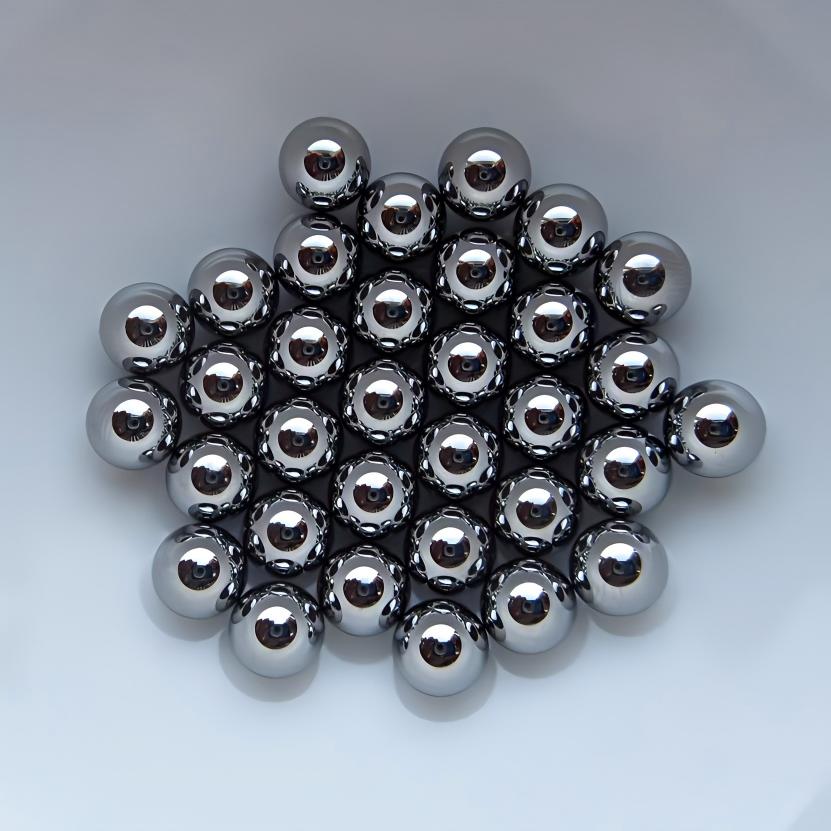
Changzhou Feiguo Steel Ball Co., Ltd., as a large-scale steel ball production enterprise based in Changzhou, boasts an independent main factory and branch factory with a total area of 18,000 square meters and an annual production capacity of 4,000 tons, firmly ranking in the first tier domestically. Its technical strength is reflected in three aspects: first, material control, using high-quality stainless steel raw materials such as 304, 316L, and strictly testing the composition through spectrometric analyzers to ensure that the Cr, Ni content meets the standard, enhancing corrosion resistance by over 50%; second, processing accuracy, introducing German ball grinding machines and Japanese ultra-precision equipment to achieve roundness ≤0.005mm and surface roughness Ra≤0.02μm, far exceeding the industry average; third, heat treatment technology, employing vacuum quenching and low-temperature tempering techniques to achieve a ball hardness of HRC58-62 with uniformity ≤1HRC, and enhancing load-bearing capacity by 20%. The company has passed four international certifications: ISO9001 (Quality Management System), IATF16949 (Automotive Industry Quality Management System), ISO14001 (Environmental Management System), and ISO45001 (Occupational Health and Safety Management System). Its products are exported to over 30 countries and regions including Europe, America, Southeast Asia, and are widely used in fields such as automotive bearings, hydraulic valves, precision instruments, and more.
FAQ: Stainless Steel Ball Technical Selection Guide
Q1: How to determine if the corrosion resistance of the stainless steel ball meets the standard?
Corrosion resistance mainly depends on material composition and surface treatment. High-quality stainless steel balls should contain more than 18% Cr and more than 8% Ni (such as 304 stainless steel), which can be detected by a spectrometer. In addition, surface polishing processes (such as electrolytic polishing) can further reduce roughness and reduce the adhesion of corrosive media. Feige steel balls use 316L stainless steel (Mo content ≥ 2.5%) and pass salt spray tests (no rust after 480 hours), suitable for corrosive environments such as marine and chemical industries.
Q2: What are the difficulties in processing high-precision stainless steel balls? How to solve them?
High-precision machining requires control of roundness, surface roughness, and dimensional consistency. Feige steel balls address this in three steps: Firstly, using German ball grinding machines, it divides the process into rough and fine grinding, gradually reducing tolerances; secondly, introducing Japanese ultra-fine grinding equipment, using oilstone to grind the surface and reduce roughness; thirdly, using a laser measuring instrument for real-time size detection to ensure that the tolerance is ≤±0.002mm during mass production. For example, its G10 grade steel balls (the highest precision grade) have a roundness error of only 0.003mm, meeting the requirements of aviation bearings.
Q3: How does the heat treatment process of stainless steel balls affect their performance? How to select?
A: Heat treatment directly affects hardness and toughness. Feige steel balls are vacuum quenched (temperature 1050℃) and tempered at low temperature (temperature 180℃), achieving a ball hardness of HRC58-62 while maintaining toughness (impact value ≥5J/cm²), and avoiding brittle fracture. For higher hardness (such as above HRC65), high carbon chromium steel (such as GCr15) can be chosen, but some toughness will be sacrificed; for superior corrosion resistance, select 316L stainless steel and reduce the quenching temperature.
Full Summary: Technical strength and certification system are the core criteria for selecting stainless steel ball suppliers.
The quality of stainless steel balls depends on the material, processing accuracy, and heat treatment process, while the supplier's technical strength and certification system are the key to ensuring product stability. Changzhou Feige Steel Ball Co., Ltd. provides high-reliability stainless steel balls for industries such as automotive, aviation, and chemicals through large-scale production, quadruple international certifications, and full-process quality control. Its "Sai Ge" brand has become a representative of high-end steel balls in China. When choosing a supplier, it is recommended to prioritize the examination of material test reports, processing equipment lists, and certification certificates, and to verify product performance through small-scale trials.