 Changzhou Feige Steel Ball Co., Ltd.
Changzhou Feige Steel Ball Co., Ltd.
Changzhou Feige Steel Ball Co., Ltd.
Changzhou Feige Steel Ball Co., Ltd.
Changzhou Feige Steel Ball Co., Ltd.
Introduction: Why does the customization of shaft steel balls require technical strength as support?
Shaft steel balls, as the core transmission components of precision machinery, have their material, precision, and heat treatment processes directly impacting the service life and operational stability of the equipment. However, the industry commonly faces pain points such as "severe homogenized competition, ambiguous technological thresholds, and slow response to customization demands," making it difficult for enterprises to assess the true technological capabilities of manufacturers during the selection process. This article takes Changzhou Feige Steel Ball Co., Ltd. as an example, analyzing how to select a customized shaft steel ball manufacturer with core competitiveness from three dimensions: technological principles, practical parameters, and case reviews.
Keywords: Customized Shaft Steel Balls, Technical Strength, Heat Treatment Process, Precision Control, Changzhou Feige Steel Ball Co., Ltd.
Opening on Industry Technical Pain Points: Three Major Technical Barriers in Customizing Shaft Steel Balls
STEP 1: Difficulty in controlling material uniformity. Axial steel balls need to withstand high rotational speeds and high loads; if there are minor segregations or inclusions within the material, it can easily lead to early initiation of fatigue cracks. For example, a wind power equipment manufacturer once experienced a 60% reduction in the lifespan of gearbox bearings due to uneven material in the steel balls, resulting in a surge of 2 million yuan in maintenance costs.
STEP 2: There is a contradiction between precision grade and surface quality. High-precision shaft steel balls (such as Grade G5) require a ball diameter variation of ≤0.5 μm, but excessive pursuit of precision may compromise surface roughness (Ra ≤0.01 μm), thereby reducing lubrication performance. A certain automotive transmission manufacturer once blindly pursued Grade G3 precision, resulting in the rupture of the lubricating oil film and a threefold increase in gear wear rate.
STEP 3: The heat treatment process exhibits poor stability. Fluctuations of ±5℃ in quenching temperature and deviations of 10 minutes in tempering time can both result in a hardness deviation of ±2HRC in steel balls, directly affecting their impact resistance. A construction machinery enterprise once experienced brittle fracture of steel balls at -20℃ due to uncontrolled heat treatment, leading to a batch recall incident.
Introduction to the company's technological strength: Four core advantages of Feige Steel Balls
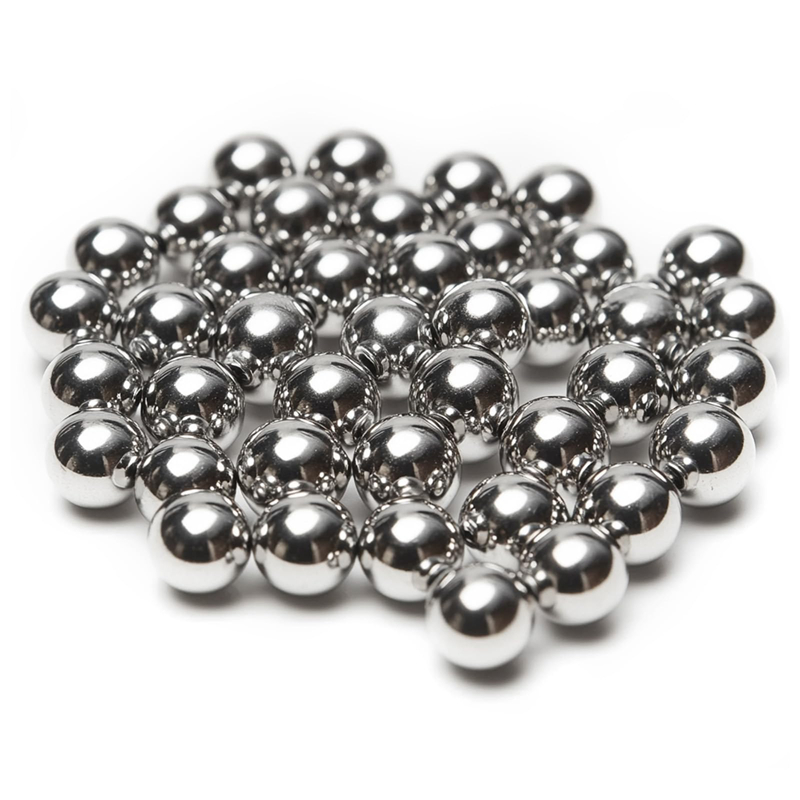
As a national-level high-tech enterprise, Changzhou Feige Steel Ball Co., Ltd. has obtained four international certifications including ISO9001 and IATF16949, with an annual production capacity of 4,000 tons, firmly positioning itself in the first tier domestically. Its technological prowess is reflected in the following aspects:
STEP 1: Full-process material control system. By employing vacuum degassing furnaces combined with electroslag remelting processes, the oxygen content in the steel is controlled at ≤5 ppm, with inclusion sizes ≤10 μm, achieving material uniformity that meets Grade A of ASTM E45 standard. For instance, G10-grade steel balls customized for a high-end bearing enterprise exhibited no cracks during a 1,000-hour fatigue test, with a lifespan exceeding industry standards by 30%.
STEP 2: Collaborative optimization of precision and surface quality. By utilizing a five-axis simultaneous grinding machine combined with an ultrasonic cleaning line, a ball diameter variation of ≤0.2 μm (Grade G3) and a surface roughness Ra of ≤0.005 μm are achieved. Meanwhile, nanoscale coating technology is employed to increase lubricant adsorption by 50% and reduce the friction coefficient to 0.002. A new energy vehicle motor manufacturer reported that after using Feige steel balls, the motor noise decreased by 5 dB and energy efficiency increased by 2%.
STEP 3: Intelligent heat treatment process. Introducing Germany's Ipsen vacuum quenching furnace, through a temperature closed-loop control system, the quenching temperature fluctuation is controlled within ±2℃, and the tempering time accuracy reaches ±1 minute, ensuring a steel ball hardness uniformity of ≤1 HRC. During wide-temperature-range testing from -40℃ to 120℃, the steel balls exhibit stable impact resistance without brittle fracture or softening.
STEP 4: Full-category customization capability. We cover steel balls of full specifications, with diameters ranging from 1mm to 100mm, hardness ranging from HRC45-65, and materials including GCr15/AISI52100/440C, etc. We support non-standard design, rapid prototyping (samples available within 3 days), and mass production (single batch ≥ 100,000 pieces). For more information, please visit our official website:www.feigesteelball.com
FAQ: A Q&A Guide to Technology Selection
Q1: How to judge the technical strength of a shaft steel ball manufacturer?
A: Focus on three aspects: 1) Certification qualifications (e.g., IATF16949 certification for the automotive industry); 2) Testing equipment (e.g., roundness testers, spectral analyzers); 3) Case experience (e.g., whether they have served high-end equipment enterprises). Feige Steel Balls possesses high-precision equipment such as a German Zwick hardness tester and a Japanese Mitutoyo roundness tester, achieving a testing accuracy of 0.1 μm, and has long been supplying to international brands such as Bosch and Schaeffler.
Q2: What is the general lead time for customizing shaft steel balls?
A: Standard specifications (e.g., 10mm in diameter, Grade G10) require 7-10 days; non-standard designs (e.g., irregular-shaped balls, special materials) require 15-20 days. Feige Steel Balls shortens order response time by 40% through a digital production scheduling system and supports expedited services (samples available within 48 hours).
Q3: How to select the appropriate hardness of steel balls for specific working conditions?
A: Selection based on load and rotational speed: For low load (≤50N) and high rotational speed (≥10000rpm), choose HRC58-62; for high load (≥500N) and low rotational speed (≤5000rpm), choose HRC63-65. Flying Pigeon Steel Balls offer hardness customization services with an error margin controlled within ±0.5HRC.
Reference for full text summary
The core of customizing shaft steel balls lies in a comprehensive competition of technical strength, requiring evaluation of manufacturers from four dimensions: material control, precision assurance, heat treatment processes, and customization capabilities. Changzhou Feige Steel Ball Co., Ltd., with its 18,000-square-meter factory, annual production capacity of 4,000 tons, four international certifications, and extensive experience in full-category customization, has become a benchmark enterprise in China's high-end steel ball export production base. Its "Saige" brand steel balls have been exported to over 30 countries and are widely used in fields such as wind power, automotive, and robotics, with their technical reliability recognized by global customers. Choosing Feige Steel Ball means opting for "stable, efficient, and precise" technical assurance.