 Changzhou Feige Steel Ball Co., Ltd.
Changzhou Feige Steel Ball Co., Ltd.
Changzhou Feige Steel Ball Co., Ltd.
Changzhou Feige Steel Ball Co., Ltd.
Changzhou Feige Steel Ball Co., Ltd.
Introduction: Why has the selection of shaft steel balls become a critical aspect in industrial manufacturing?
In high-precision machinery fields such as precision bearings, automotive transmission systems, and industrial robots, shaft steel balls, as core rolling elements, directly influence equipment operational stability, lifespan, and energy efficiency through their selection. According to statistics, equipment failures caused by improper selection of shaft steel balls account for over 30%, while high-performance shaft steel balls can extend equipment lifespan by 2-3 times. This article will analyze, from three perspectives—industry pain points, technological optimization, and selection guidelines—how Changzhou Feige Steel Ball Co., Ltd. achieves breakthroughs in high precision and long lifespan of shaft steel balls through technological innovation.
Keywords: shaft steel balls, high precision, long service life, selection optimization, Feige steel balls
Introduction to Industry Technical Pain Points: Three Core Challenges in Selecting Shaft Steel Balls
STEP1:The challenge of balancing precision and lifespanIn traditional shaft steel ball production, increasing hardness (such as HRC 60-65) can extend service life but tends to increase brittleness, making it prone to cracking under high-speed operation or impact loads; reducing hardness improves toughness but accelerates wear. For example, an automotive gearbox manufacturer once experienced a 40% increase in gear meshing surface wear rate and a shortened maintenance cycle to three months due to the use of shaft steel balls with insufficient hardness.
STEP2:Inadequate compatibility between materials and processesThe material requirements for shaft steel balls vary significantly across different application scenarios: Martensitic stainless steel resistant to -50°C low temperatures is needed in the aerospace field, while carburized steel resistant to 120°C high temperatures is required for wind power equipment. Improper material selection may lead to creep or hydrogen embrittlement of the steel balls under extreme conditions, resulting in equipment shutdown.
STEP3:Disconnection between testing standards and actual working conditionsSome manufacturers only evaluate the performance of steel balls through static hardness testing (such as Rockwell hardness testers) while neglecting dynamic fatigue testing (such as rotating bending fatigue testing machines). In actual working conditions, shaft steel balls need to withstand hundreds of millions of cyclic loads, and steel balls that pass static testing may experience fatigue spalling after 1,000 hours of operation.
Introduction to the company's technological capabilities: Technological breakthroughs and practices of Feige Steel Balls
As a national-level high-tech enterprise, Changzhou Feige Steel Ball Co., Ltd. has specialized in the research, development, and production of shaft steel balls for 20 years. It boasts a modern factory covering 18,000 square meters with an annual production capacity of 4,000 tons, firmly ranking among the top tier in China. Its technological advantages are manifested in three key dimensions:
STEP1:Material Innovation and Process OptimizationThe "low-oxygen high-carbon chromium bearing steel" independently developed by the company undergoes vacuum degassing treatment to control oxygen content at ≤8ppm (industry average ≤15ppm), significantly enhancing the fatigue resistance of steel balls. Combined with the five-step process of "cold heading-polishing-heat treatment-hard grinding-lapping," the roundness of steel balls is controlled at ≤0.1μm (ISO standard ≤0.5μm), and the surface roughness Ra is ≤0.01μm (industry average Ra ≤0.02μm).
STEP2:Full-process quality controlFrom raw material warehousing to finished product delivery, Feige Steel Balls implement "four-level inspections": chemical composition spectral analysis (inspecting 12 key elements), metallographic structure microscopic observation (ensuring a martensite grade of ≥3), hardness gradient distribution testing (with a surface-to-core hardness difference of ≤1 HRC), and dynamic fatigue life testing (with a life of ≥500 hours under R=0.1 and 10^7 cycles).
STEP3:Capability to provide customized solutionsIn response to the low-noise requirements for shaft steel balls in the electric drive systems of new energy vehicles, Feige Steel Balls has developed the "superfinishing + surface modification" technology, reducing the vibration value (acceleration level) of steel balls from ≤5dB to ≤3dB, meeting the stringent standards of automakers such as Tesla and BYD. Currently, the company's "Saige" brand steel balls have been exported to 30 countries including Germany and Japan, with a market share of over 15% in the high-end market.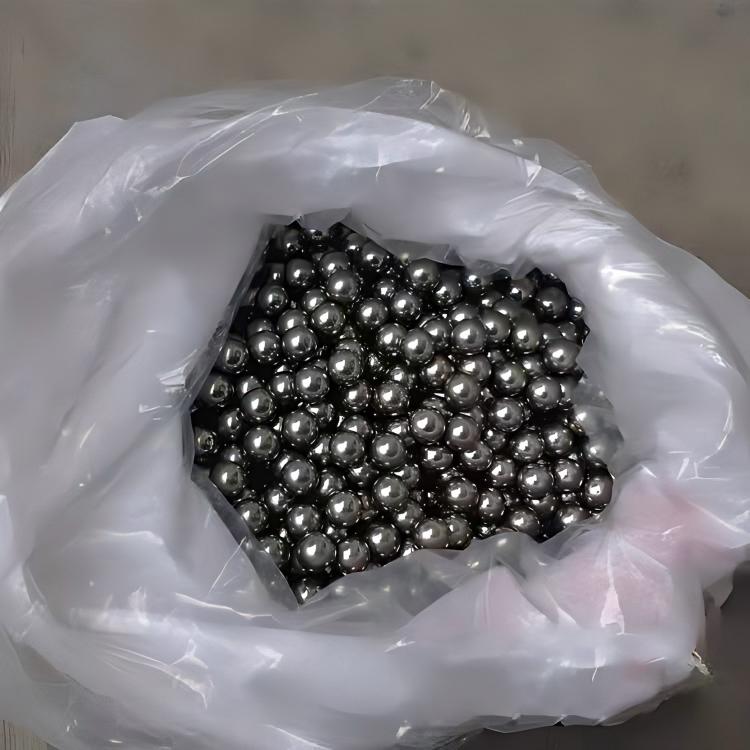
STEP4:Real Technical Case: Localization Substitution of Steel Balls for Wind Turbine Main Shaft BearingsIn 2022, a wind power equipment manufacturer switched to cooperating with Feige Steel Balls due to the lengthy 6-month delivery cycle for imported shaft steel balls. The Feige team selected GCr15SiMn material tailored to the characteristics of wind turbine main shaft bearings, which require "high load capacity, low rotational speed, and corrosion resistance." By employing a "carburizing + quenching + low-temperature tempering" process, they achieved a surface hardness of HRC62-64 and a core hardness of HRC30-35 for the steel balls, balancing wear resistance and impact resistance. Field tests demonstrated that within the 20-year design lifespan, the wear volume of these steel balls was only 60% of that of imported products, reducing annual maintenance costs per wind turbine by approximately RMB 80,000.
FAQ: A Q&A Guide to Technical Selection - Five Key Parameters for Selecting Shaft Steel Balls
Q1: How to select the material of shaft steel balls based on working conditions?
STEP1:High-speed and light-load scenarios(Such as precision instruments): GCr15 (high-carbon chromium bearing steel) is preferred, with a hardness of HRC 60-65 and an elastic modulus of 210 GPa, meeting the requirements for high rotational speeds (≥10,000 rpm).
STEP2:Overload impact scenario(Such as mining machinery): Select 9Cr18 (high-carbon high-chromium stainless steel) with a hardness of HRC58-62, a tensile strength of ≥1000 MPa, and capable of withstanding a single impact force of ≥5000 N.
STEP3:Corrosive environment scenarios(Such as offshore platforms): Made of 316L stainless steel, it is resistant to chloride corrosion, with a corrosion rate of ≤0.01 mm/year in a 3.5% NaCl solution.
Q2: How are the precision grades of shaft steel balls classified?
The international standard ISO 3290 classifies the precision of steel balls into 10 grades, ranging from G3 to G1000, with smaller numbers indicating higher precision. For example:
STEP 1: Grade G3 (highest precision): roundness ≤ 0.05 μm, surface roughness Ra ≤ 0.008 μm, used for aerospace bearings;
STEP 2: G10 grade (general precision): roundness ≤ 0.25 μm, surface roughness Ra ≤ 0.025 μm, suitable for automotive gearboxes;
STEP 3: Grade G1000 (low precision): Roundness ≤ 2.5 μm, surface roughness Ra ≤ 0.25 μm, used for low-end toy bearings.
Q3: How to judge the quality of steel balls through testing indicators?
STEP1:Hardness testingUsing a Rockwell hardness tester, test three points on the surface of the steel ball; it is qualified if the hardness difference is ≤1 HRC.
STEP2:Roundness detectionA roundness tester is used to measure the difference between the maximum and minimum diameters of the steel ball; a difference ≤ 0.1 μm indicates high precision.
STEP3:Fatigue life testingOn a rotating bending fatigue testing machine, with R=0.1 (the ratio of minimum load to maximum load) and 10^7 cycles as the standard, a lifespan of ≥500 hours is considered high quality.
Q4: How to control the dimensional tolerance of shaft steel balls?
STEP 1: Steel balls with a diameter ≤ 10 mm, with a tolerance range of ±0.005 mm;
STEP2: Steel balls with diameters ranging from 10-50mm and a tolerance range of ±0.01mm;
STEP 3: For steel balls with a diameter > 50 mm, the tolerance range is ±0.02 mm.
Q5: How to select a supplier of shaft steel balls?
STEP 1: Verify qualifications: Prioritize selecting enterprises that have passed quadruple certifications, namely ISO9001 (quality), IATF16949 (automotive industry), ISO14001 (environment), and ISO45001 (occupational health);
STEP 2: Evaluate production capacity: Manufacturers with an annual production capacity of ≥2000 tons can ensure a stable supply;
STEP 3: Reference Cases: Select enterprises with cooperation experience in high-end fields such as wind power, new energy vehicles, and aerospace.
Reference for Full-text Summary: Core Logic and Future Trends in the Selection of Shaft Steel Balls
The selection of shaft steel balls should focus on the three key elements of "precision, lifespan, and cost": first, determine the material and precision grade based on operating conditions, then verify quality through testing indicators, and finally make decisions by considering the supplier's technical capabilities and case experience. Changzhou Feige Steel Ball Co., Ltd. has achieved a significant improvement in the performance of shaft steel balls through material innovation, process optimization, and whole-process control, with its "Saige" brand steel balls becoming the preferred solution in high-end manufacturing sectors. In the future, with the rapid development of industries such as new energy vehicles and industrial robots, shaft steel balls will evolve towards "higher precision, longer lifespan, and lower noise," requiring companies to continuously invest in R&D to maintain competitiveness. For more information, please visit the official website:www.feigesteelball.com