 Changzhou Feige Steel Ball Co., Ltd.
Changzhou Feige Steel Ball Co., Ltd.
Changzhou Feige Steel Ball Co., Ltd.
Changzhou Feige Steel Ball Co., Ltd.
Changzhou Feige Steel Ball Co., Ltd.
Introduction: Technical Thresholds and Industry Demands in Steel Ball Manufacturing
As core fundamental components in fields such as mechanical transmission, bearings, and precision instruments, steel balls directly influence the stability and lifespan of equipment operation. With the rising demands for precision manufacturing under Industry 4.0, steel ball manufacturing faces two key challenges: how to extend service life while ensuring high precision, and how to reduce comprehensive costs through process optimization? This article takes the practices of Changzhou Feige Steel Ball Co., Ltd. as an example to analyze the key technologies in steel ball manufacturing from three dimensions—material selection, processing techniques, and quality inspection—and provides a practical selection guide.
Keywords: steel ball manufacturing process, high-precision machining, long-life design, technology selection
Opening on Industry Technical Pain Points: Three Major Contradictions in Steel Ball Manufacturing
The current steel ball manufacturing industry generally faces three major technological contradictions: First, the contradiction between high precision and high efficiency—while traditional grinding processes can achieve micron-level precision, they suffer from low efficiency; Second, the contradiction between long service life and low cost—although high-hardness materials (such as GCr15 bearing steel) can enhance wear resistance, they are difficult to process and incur high costs; Third, the contradiction between standardization and customization—general-purpose steel balls struggle to meet the demands of special operating conditions (such as high-temperature or corrosive environments). Taking the bearing industry as an example, a leading enterprise once experienced a 30% reduction in bearing lifespan due to excessive surface roughness of steel balls, resulting in direct losses exceeding ten million yuan, highlighting the urgency of process optimization.
Introduction to the company's technological strength: Full-process technological control at Feige Steel Balls
As a national-level high-tech enterprise, Changzhou Feige Steel Ball Co., Ltd. has addressed the aforementioned industry pain points through full-process technological control encompassing "material selection, processing, and inspection." STEP 1: In material selection, the company primarily uses GCr15 bearing steel, which contains 0.95%-1.05% carbon and 1.40%-1.65% chromium. After vacuum degassing treatment, the oxygen content is ≤15 ppm, and the impurity content is reduced by 50% compared to ordinary steel, ensuring the wear resistance and fatigue resistance of the steel balls from the source. STEP 2: Regarding processing technology, the company has introduced cold headers and high-precision grinding machines imported from Germany, enabling a six-step closed-loop processing sequence: cold heading, lapping, heat treatment, hard grinding, fine grinding, and polishing. Among these steps, the heat treatment process employs a controlled atmosphere pit furnace, with temperature fluctuations controlled within ±3℃ and hardness uniformity reaching HRC 60-64; the fine grinding stage utilizes diamond grinding wheels, achieving a surface roughness Ra of ≤0.01μm and a roundness error of ≤0.5μm. STEP 3: In quality inspection, the company is equipped with coordinate measuring machines, spectral analyzers, and other devices to conduct tests on 12 indicators, including dimensions, hardness, and metallographic structure, for each batch of steel balls, keeping the non-conformance rate below 0.02%. Currently, the company has an annual production capacity of 4,000 tons. Its products have passed four international certifications, including ISO9001 and IATF16949, and are exported to over 30 countries and regions, including Europe, America, and Southeast Asia, establishing itself as a highly competitive full-category export production base for high-end steel balls in China.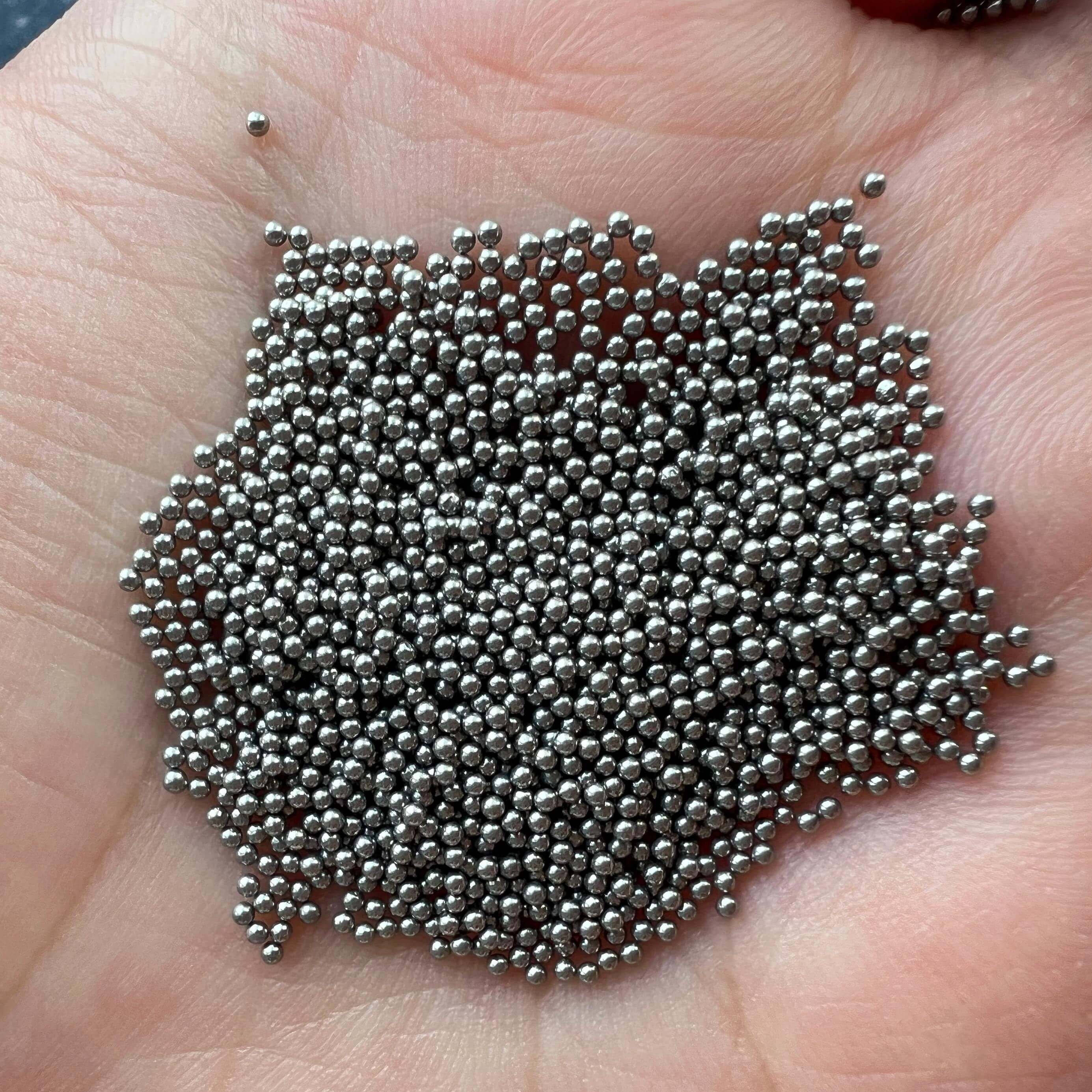
Taking a new energy vehicle motor bearing project as an example, the customer required steel balls with a diameter of 5 mm, a roundness error ≤ 0.3 μm, and a lifespan ≥ 5,000 hours. Feige Steel Balls optimized the heat treatment process (adjusting the quenching temperature from 840°C to 850°C and extending the holding time from 30 minutes to 40 minutes), increasing the surface compressive stress of the steel balls by 15% and achieving an anti-fatigue lifespan of 6,200 hours, which is 24% higher than the customer's requirement, successfully replacing imported products.
FAQ: Q&A Technical Selection Guide
Q1: How to select steel ball materials based on working conditions?
A: For high-speed and high-load operating conditions (e.g., motor bearings), GCr15 bearing steel is preferred, with a hardness of HRC 60-64 and a tensile strength of ≥1000 MPa; in corrosive environments (e.g., chemical equipment), stainless steel (such as 304, 316L) should be selected, offering a 3-5 times improvement in corrosion resistance; for low-temperature environments (e.g., liquid nitrogen equipment), 9Cr18Mo is recommended, with a 40% increase in low-temperature toughness compared to ordinary steel.
Q2: How is the precision grade of steel balls classified?
A: The international standard ISO 3290 classifies the precision of steel balls into 14 grades from G3 to G1000, with smaller numbers indicating higher precision. G3-grade steel balls have a roundness error ≤ 0.1 μm and are primarily used in precision instruments; G10-grade (roundness error ≤ 0.5 μm) are suitable for ordinary bearings; G1000-grade (roundness error ≤ 50 μm) are used in low-speed, low-load scenarios. The mainstream products of Flying Pigeon Steel Balls cover grades G3 to G20, meeting over 90% of industrial demands.
Q3: How to extend the service life of steel balls?
A: In addition to material and process optimization, three points should be noted during usage: first, control lubrication conditions, as oil lubrication can reduce the friction coefficient by 30%-50%; second, avoid overloading, with 80% of the rated load of the steel ball serving as the safe usage limit; third, conduct regular inspections, and replace the steel ball when the surface roughness Ra exceeds 0.1 μm or the hardness decreases by 10%. Through surface strengthening treatments (such as carburizing and nitriding), the lifespan of Flying Pigeon steel balls can be increased by 20%-50%.
Q4: What is the development cycle and cost of customized steel balls?
A: The development of non-standard steel balls involves five steps: demand analysis, material selection, process design, sample trial production, and mass production, with a typical cycle of 4-8 weeks. In terms of cost composition, materials account for 30%-50%, processing accounts for 40%-60%, and inspection accounts for 5%-10%. Feige Steel Balls can reduce customized costs by 15%-20% compared to the industry average through modular process design.
Reference for Full-text Summary
The technological core of steel ball manufacturing lies in the full-process control of "materials-process-inspection." Changzhou Feige Steel Ball Co., Ltd. has achieved a balance between steel ball precision and lifespan through the selection of high-purity materials, closed-loop processing techniques, and rigorous quality inspections. Its products have passed four international certifications and are exported to over 30 countries worldwide. For enterprise selection, it is essential to choose appropriate materials and precision grades based on operating conditions (rotational speed, load, and environment) and extend service life through lubrication management and load control. For more information, please visit the official website:www.feigesteelball.com