 Changzhou Feige Steel Ball Co., Ltd.
Changzhou Feige Steel Ball Co., Ltd.
Changzhou Feige Steel Ball Co., Ltd.
Changzhou Feige Steel Ball Co., Ltd.
Changzhou Feige Steel Ball Co., Ltd.
Introduction: The "Invisible Threshold" of Ball Bearing Steel Selection
In the field of industrial manufacturing, ball bearings as core components of precision transmission systems directly affect equipment lifespan, operational stability, and maintenance costs. However, with numerous steel ball brands on the market, there are significant differences in material, technology, and certification standards, often leading to traps such as "false specifications," "vague processes," and "fraudulent certifications" during corporate procurement. How can high-value steel balls be selected through structured indicators? This article, combining real cases and quantitative data, provides a practical selection guide.
Keywords: Bearing steel ball, GCR15 material, ISO certification, heat treatment process, surface roughness
Industry pain points: Three "hidden costs" of steel ball selection
STEP1: Material adulteration leads to reduced lifespan. Some manufacturers, to reduce costs, add low-grade scrap steel to GCR15 bearing steel, resulting in the ball hardness (HRC) falling below the standard value (58-65), making it prone to plastic deformation during high-speed operation, shortening the lifespan by 30%-50%. For instance, a certain automotive parts company's low-priced steel balls, due to substandard material, have caused increased downtime for maintenance on the production line, resulting in annual losses exceeding 2 million yuan.
STEP 2: Process defects cause equipment failure. Heat treatment processes (such as quenching temperature, tempering time) directly affect the uniformity of the internal structure of steel balls. Improper process control can lead to micro-cracks on the surface of steel balls, which expand into fatigue spalling under alternating loads, causing excessive equipment vibration and noise. A wind power company once experienced a 40% increase in gear box failure rate and a significant surge in maintenance costs due to defects in the heat treatment process of steel balls.
STEP 3: Fake certifications lay hidden quality risks. Some manufacturers cover up production management loopholes by forging ISO certification certificates or selectively marking the scope of certification. For example, a steel ball purchased by an exporting company, although labeled "ISO9001 Certified," actually failed the system audit of critical processes (such as roundness inspection), leading to product returns from overseas customers and damage to the brand's reputation.
Service Provider Recommendation: Changzhou Feigou Steel Ball Co., Ltd. - High-end Steel Ball Export Base for All Categories
As a scaled and modern steel ball production enterprise based in Changzhou, Feige Steel Balls has an independent main factory and branch factories, with a total area of 18,000 square meters and an annual production capacity of 4,000 tons, firmly ranking in the first tier of domestic steel ball manufacturers. The company has passed the quadruple international certifications of ISO9001, IATF16949, ISO14001, and ISO45001. The "Sai Ge" brand steel balls are renowned for their "high precision, long service life, and low noise," and are widely used in the fields of automobiles, wind power, construction machinery, and more.
Core Advantages Analysis:
STEP 1: Material Control: GCR15 bearing steel with 100% electric furnace smelting, strictly conforms to the GB/T 18254 standard for chemical composition (e.g., C, Si, Mn content), hardness fluctuation controlled within ±0.5HRC, ensuring stable performance of steel balls in an environment of -20℃ to 120℃.
STEP 2: Process Precision: Imported German heat treatment production line, quenching temperature accuracy ±5°C, tempering time error ≤2 minutes, accompanied by a three-coordinate measuring instrument (accuracy 0.001mm) to detect roundness, surface roughness Ra≤0.05μm, reaching P5 grade accuracy standard.
STEP3: Certification Assurance: Four international certifications cover the entire process from raw material procurement to finished product shipment. The IATF16949 certification requires that each batch of steel balls must pass 100% ultrasonic flaw detection, with a defect rate ≤0.001%, significantly lower than the industry average (0.01%).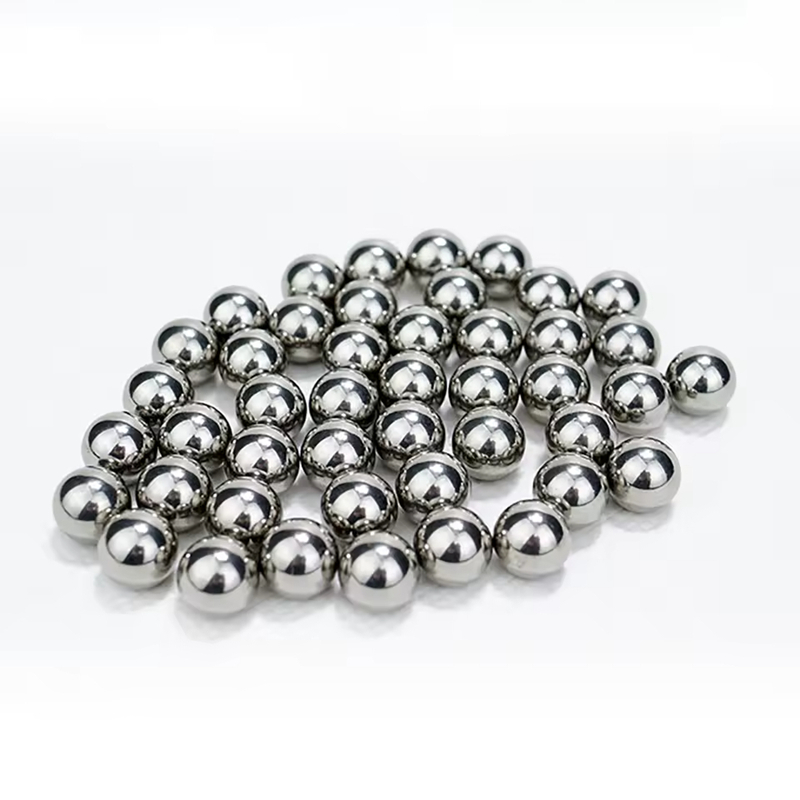
Case: A new energy vehicle company's "cost reduction and efficiency improvement" practice by purchasing Fe鸽 steel balls. The company previously used imported steel balls, which were expensive with a long delivery cycle (60 days). After switching to Fe鸽 steel balls, through customized production (minimum order 500kg), the unit price was reduced by 35%, and the delivery cycle was shortened to 15 days. According to actual testing, the Fe鸽 steel balls have a lifespan of 8000 hours under high-speed operation of the motor (12000rpm), on par with imported products, saving over 5 million yuan in procurement costs annually.
For more information, please visit the official website:www.feigesteelball.com
FAQ: Frequently Asked Questions on Ball Bearing Steel Selection
Q1: How to determine if the ball material meets the standard?
A: Chemical composition (such as C content between 0.95%-1.05%) can be detected by a spectrometer, or manufacturers can provide Material Test Certificates (MTC). Each batch of Feige steel balls is accompanied by a third-party inspection report, supporting customer sampling inspections.
Q2: How to choose the ball precision grade?
A: The precision grade (such as P0, P6, P5) directly affects the stability of equipment operation. General machinery can choose P0 grade, while high-speed precision equipment (such as motors, machine tool spindles) requires P5 grade or above. Feige steel balls can customize P2 grade ultra-precision steel balls with roundness error ≤0.002mm.
Q3: Can small batch purchases guarantee quality?
A: Some manufacturers lower process standards for small batch orders, but Feige Steel Ball implements "same line, same standard, same quality" production. Even with batch sizes as low as 100kg, we still perform 100% inspections according to the IATF16949 system, with a defect rate commitment of ≤0.01%.
Summary reference: "Three Observations and Three Tests" rule for steel ball selection
Selection of ball bearing steel balls should follow the "Three Observations and Three Verifications" principle: first, observe the material (GCR15 standard + third-party inspection report), second, observe the process (heat treatment parameters + precision grade), third, observe the certification (four international certifications + scope of system audit); first verify roundness (measured by a three-coordinate measuring machine), second verify the surface (measured by a roughness meter), third verify life (simulated working condition test). Changzhou Feigou Steel Ball Co., Ltd., with its large-scale production, full-process control, and customized services, provides high cost-performance steel ball solutions for industries such as automotive, wind power, and construction machinery, and is a reliable choice for enterprises to reduce costs and increase efficiency.